



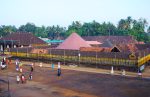
THRIPRAYAAR TEMPLE
The Thriprayar Sree Rama Temple is one of the renowned Vishnu temples in Kerala. According to legend, fishermen who went out to the sea caught four divine idols—Sree Rama, Bharata, Lakshmana, and Shatrughna. Among these, the idol of Sree Rama was consecrated at Thriprayar. It is said that a divine peacock was prophesied to appear above the exact spot where the idol should be placed. When the peacock did not appear as expected, the idol was consecrated anyway. However, the divine peacock later manifested itself, and the stone for offering sacrifices (Balikkallu) was placed beneath where the peacock appeared. Legend has it that the stone would shake until the mystic Naranathu Bhrathan chanted mantras and hammered a nail into the stone to stop the movement.
As a remedial measure for the positioning of the Sree Rama idol in improper place, Narayanath Bhranthan instructed that Sri Devi be consecrated to the right of the deity and Bhumi Devi to the left. It is believed that the saint Vilwamangalam Swamiyar, upon visiting the temple, witnessed Sri and Bhumi Devi coming to worship Sree Rama, and hence they were consecrated to the left and right of the deity before Vilwamangalam Swamiyar sealed the western gate.
On the southern side of the sanctum (Sreekovil) is the deity of Dakshinamurti, and inside the temple complex, there is also the presence of Ganapati and a ceremonial lamp (Pinvilakku). This suggests that the temple carries a blend of both Shaiva (Shiva) and Vaishnava (Vishnu) energies. The idol of Sree Rama in this temple is said to embody a fierce form of the deity, connected to the Khara Vadha episode in the Ramayana, symbolizing both Shaiva and Vaishnava influences.
Before the temple became dedicated to Sree Rama, it is believed that the site was originally a Sastha temple. Even today, Dashami Vela and Pathamudayam festivals are celebrated in honour of Sastha. Devotees often worship the deity here to seek relief from various afflictions and disturbances. On the northern side of the temple, there is a shrine dedicated to Goshalakrishnan. The temple also holds a spiritual presence of Hanuman and Chathan in concept.
It is customary for devotees to first offer their prayers to Hanuman, who is symbolically present in the temple mandapam, before proceeding to seek the blessings of Sree Rama.
At the Thriprayar Temple, the day begins at 3:00 AM. After the Paaravukaran (temple watchman) strikes the clock at 3:00 AM, there are three ceremonial fireworks followed by nine shankh (conch) blasts. The temple opens its doors at 4:00 AM. The first offering is Trimadhuram (a sweet offering). The Usha Pooja and Ethruthu Pooja (early morning poojas) are performed at 5:00 AM. After the pooja, the temple reopens at 7:15 AM. The morning Sheeveli (ritual procession) includes three rounds around the temple with the deity, where the deity is taken outside and back inside. At 9:00 AM, the Pantheeradi Pooja (mid-morning pooja) takes place, and at 11:00 AM, the Ucha Pooja (midday pooja) is performed after the Navakam ritual. The temple opens at 12:00 noon. The noon Sheeveli is conducted before closing the temple.
During the Mandala season (a special period of worship), the evening Sheeveli takes place at 5:00 PM. There is an elephant for the processions in both the morning and evening Sheeveli. During Mandala season, all three Sheeveli processions feature an elephant. The temple reopens at 4:15 PM for the Deeparadhana (evening prayer with lamps), followed by the Athazha Pooja (night pooja). After the Athazha Sheeveli, the temple doors are closed for the day.
The Prathishta day, celebrated in the Malayalam month of Medam (Punartham star), includes a Dravya Kalasam during the midday pooja, with three elephants participating in the Sheeveli. In the morning, there is a Panchari (a specific type of percussion), Dhruvam at noon, and Panchari again in the evening. On the 10th of Dhanu, Pathamudayam is celebrated. After the Pantheeradi Pooja, a morning Sheeveli is performed. On important days like Ekadashi, Prathishta Dinam (consecration day), Pathamudayam, Onam, and Vishu, the Sheeveli follows this routine.
On the Thiruvonam day of Kanni month, during the Chirakettu day, there will be fireworks and conch blowing during the Nivedyam (offering of food). Poojas are completed earlier on this day. During Pathamudayam and Dashami vela, Lord Sastha is taken out in a procession. Special rituals are performed for Gosala Krishna on Ashtami Rohini, including a Kalabham (sandal paste offering).
The Ekadashi in the month of Vrischikam (Krishna Paksha Ekadashi) is particularly special at Thriprayar. The Niramala ritual begins 22 days before Ekadashi. At 1:00 AM on Ekadashi, there is a ceremonial procession called Vilakkinezhunellippu, following which, devotees offer Kaanikka (offerings) to the Lord with great devotion.
At the Thriprayar Temple, fireworks (Kathina) offerings hold special significance. According to legend, after Hanuman returned from his mission to find Sita, he informed Lord Rama about the successful search by saying, “Seen Sita, tto”. (in Malayalam ‘tto’ is a colloquial usage). The last sound of the word, “tto”, is said to have been immensely satisfying to the Lord. In the year 956–57, when Tipu Sultan attacked the temple, he threw the Kathina into the river, challenging, “If there is power, let them get fired”. It is said that the Kathinas indeed got fired upon hitting the water. Along with the regular offerings of Aval Nivedyam (flattened rice), Meenootu (ritual feeding), and Payasam (sweet rice pudding), there is also a unique ritual called KoothuPurappadu. This performance is conducted in the Mukhamandapam (main hall) in the presence of the deity and has continued without interruption to this day.
The grand Pooram festival ceremonies begin with purification rituals. On the Karthika star day in the evening and the Rohini star day in the morning, these purification ceremonies are completed. In the month of Meenam, on the Makiram star day, the Usha Pooja (early morning pooja) is conducted. The Karkidakam zodiac (month-ending Pooram), depending on the alignment of the stars, can occur earlier or later in the day. Usually, around 1:30 PM, the Oorayma (temple authorities) assemble in the Mandapam (hall) to give permission for the deity’s procession. The ritual starts with the lighting of lamps and the beating of the Pani (traditional drums), and the deity is taken out in procession. The ceremonial right to the first Para (rice offering) belongs to the Nambiar family.
After the Brahmani Pattu (devotional songs), the deity is taken on a procession. If there are devotees with sorrow or concerns, they believe their worries will be alleviated by this time. When the deity is placed on the elephant, traditional fireworks of 1001 Kathina shots are fired, followed by a one-and-a-half-round circumambulation of the temple. Afterward, the deity is taken to the Sethu Kulam (holy tank) for the Aarattu (ritual bath).
The first rice offering of the day happens at the Padippura, the temple entrance. The deity, accompanied by five elephants and a grand Pandimelam (traditional percussion ensemble), is taken back into the temple. This Pooram (festival) is for both Shree (Goddess Lakshmi) and Bhoomi (Goddess Earth), and thus all morning poojas, including Pantheeradi, Shreebhoota Bali, Navakam, and Athazha Pooja, are repeated. In the night, the temple conducts the Chembil Arattu (bath ritual) to conclude the day’s celebrations.
On Thiruvathira day, at 8 AM, the Pooram (festival) procession with three elephants proceeds to Puthankulam for the Aarattu (ritual bath) and returns to the temple for Pooja (worship). At 4 PM, the procession sets off for the Kattur Pooram. Offerings are made at the Krishna Temple under the Thrippunithura Kovilakam, as well as at Kuruppillam Moosa’s illam (household). The procession returns to Puthankulam for the Aarattu, followed by Athazha Pooja (night pooja) and Sheeveli (a ceremonial procession). Even if the deity leaves the temple before the ceremonial Kathina fireworks (Niyamavedi), the votive fireworks will take place at the precise time. EdathiruthiPaadam, On the day of the Kattur Pooram it is at Edathiruthi Paadam,
On Punartham day, after the Aarattu at Blaha-Kannampilli Chira, the temple rituals continue until Ucha Pooja (noon pooja). Later, the procession moves to Kurukkan Kulam for another Aarattu. On Pooyam day, the Aarattu is held at Valappat Kothakulam. Then the elephant performs a symbolic act called Chalu kuyhal (three times) at Paynur. There are nine conch blasts for the Chalukuthal (ritual). That day, the morning poojas continue at the temple. Evening arattu at Kurukkan kulam. Offerings are made at the various Illams (households). The Athazha Pooja and AthazhaSheeveli are also conducted at the temple.
On Ayilyam day, the Aarattu takes place in the morning at Puthankulam, followed by offerings at Samuhamadam. The evening features Niyama Vedi (fireworks), and the deity is taken in procession to Puzhakkara for the Chelur Pooram. At Palliyodam Kolam with the Thidambu is placed on a boat and ferried across the river. After receiving offerings (Para -rice) at Chelur, Punnapilli, and performing the Aarattu at Kuttan Kulam, the deity is brought to Sastha Temple for worship. The next morning, the deity returns for the Aarattu at Puthankulam.
On Makam day, the evening poojas of the previous day are completed, along with the Usha Pooja in the morning and the Aarattu at Puthankulam. By 5:30 PM, the procession departs for the Thantri Illam (house) via a boat, crossing the river to Ammath Kulangara Ambalapadi. After the ceremonial fireworks, offerings are made at Cherumukku mana before proceeding to Padinjare Tharananellur Mana. The deity is taken to the Thantri’s house in a grand procession with three elephants, accompanied by Panchavadyam (traditional music) and Pandimelam (percussion). Worship and offerings are conducted, followed by the Chembil Aarattu (a sacred bath ritual).
After leaving the Thantri Illam, the deity heads to Vettalasseri Ambalam, where a ceremonial fireworks display takes place in the morning. Offerings are also made at Chazhoor Temple, AvanangatPadikkal, and other households before the deity returns to the temple for the Aarattu at Puthankulam.
On the day of the Pooram, the Athazhapooja (night pooja) and Sheeveli from Makam day are carried out. After the Ushapooja (morning pooja), the Aarattu takes place in Puthankulam at 5 PM. At the time of the Nivedyam, ceremonial fireworks are set off, followed by a conch blast, and the AthazhaSheeveli (procession) proceeds without elephants. After the ritual, the Thrikovil Shanti (chief priest) leads the deity across the river in a boat. Upon reaching the Mandapam, the pooja and traditional fireworks are conducted, after which the deity moves to Aarattupuzha for the grand festival. The procession stops at Chirakkal for a pooja, and from Irinjalakuda, the sacred garland from the Manikya Temple is adorned on the deity, who rides on his own elephant.
The procession continues from Pallissery to Kaithavalappu, with Eleven Elephants and Panchavadyam (traditional orchestra) leading the way. By noon, when the Chothi Nakshatram is in its zenith, the procession reaches Aarattupuzha. Here, three ceremonial fireworks are followed by a grand display of 1001 Kathinas. The Tevar deity is stationed on the Thevar road, and the votive fireworks take place on the southern side of the Tevar Thara.
At Aarattupuzha, Thever stands on Varambu. Urakathamma and Cherpu Bhagavathy stand on either side for a combined procession. After their melam (musical performance) ends, the procession heads to Mandaram Kadavu for the Aarattu. The Nivedyam ritual performed at Kadavu and it is believed to be highly effective for curing digestive ailments, and devotees take part in the offering. The second Aarattu takes place along with Uurakathamma and after the PattiniShankhu (conch ritual), the offerings are made at the Shasta Temple. Arattupuzha Sastha accompanies Thriprayar Thevar until Ezhu Kandam (Seventh plot of paddy field). Then an astrologer announces the date for the next year’s pooram day.
Following this, the procession heads to Vendasseri Ambalam for rest, and after a meal of Uchchakkanji (midday gruel), the procession returns to the temple by 3 PM. After the Ushapooja, the Sanctum Sanctorum gates are closed. In the evening, when the gates reopen, the Ooraaymakkar (temple caretakers) give permission to light the lamps, and the Brahmani Pattu (sacred song) is performed in the Mandapam with the deity present. The procession exits the temple with five elephants and Panchavadyam, accompanied by fireworks. After the Aarattu at Sethu Kulam, the return procession continues with Pandimelam. All the poojas from the day of Pooram are carried out on Uthram day.