


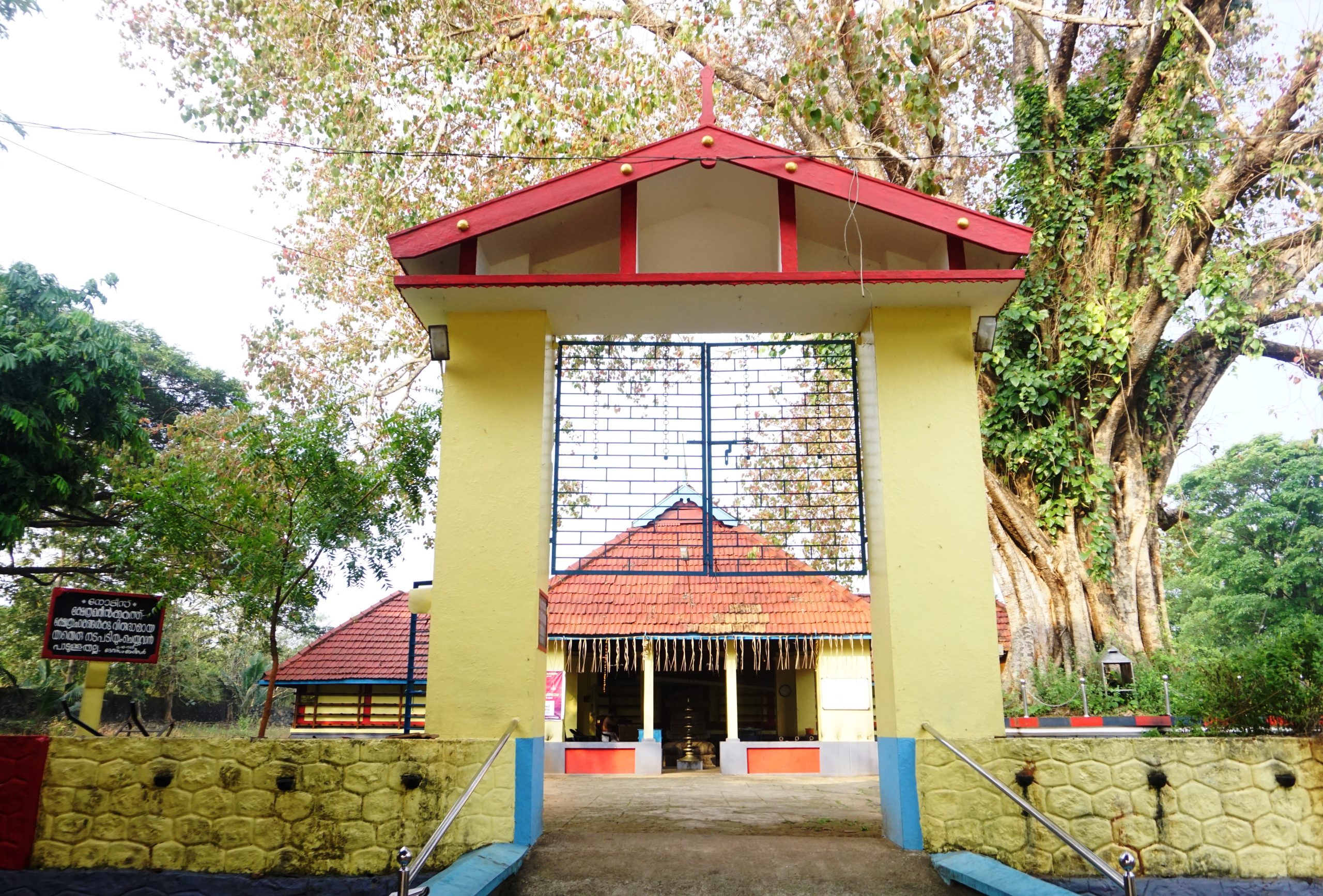
THOTTIPPAL BHAGAVATHY TEMPLE.
The historical fact that Parashurama, the creator of Kerala, established 108 Durga temples across the land for its overall prosperity and entrusted their upkeep to esteemed Brahmins, still holds true today. However, another legend suggests that Parashurama’s actions were motivated by his desire to atone for the sin of killing his mother, based on his father’s command. Regardless of the reason, there is no dispute that these Durga temples are creations of Parashurama. One of the most significant among them is the Thottippal Bhagavathi Temple, known for its extensive temple system.
The goddess, who is worshipped in her eternal virgin form, continues to bestow blessings and protection upon her devotees and those who seek her refuge.
The remnants of the temple, including the Anavayran (elephant belly) wall and the intricately carved sculptures in the temple’s sanctum sanctorum, clearly reflect the grandeur of its glorious past. In 1173, prior to the temple’s renovation ceremony, a significant amount was spent by the temple committee to restore the sanctum sanctorum while maintaining its original character. It is undeniable that this sanctum is a major asset for the Cochin Devaswom Board. During Tipu Sultan’s invasion, this temple suffered destruction. When the devastation affected the region, the patriarchs of two Nair families from the village, Chillaayil Krishnamenon Modikkaran and Malayattur Kunjikrishnamenon, swore to rebuild and reconsecrate the temple.
Accordingly, Sri Chillaayil Krishnamenon Modikkaran initiated the reconstruction of the temple. However, he passed away before its completion. To fulfil the promise, Kunjikrishnamenon completed the reconstruction and performed the reconsecration. Despite the fact that the idol was not fully completed before the auspicious time for the ceremony, it was decided to install it as it was. Since the defect was on the right side of the idol, it is believed by devotees that those residing on the left side experience greater prosperity.
The temple originally had three trustees: Ponnumpulakkal Illam, Perunthadampu, and Kayyappilly Mana.
The Ponnumpulakkal Illam family handed over their rights to the local rulers of Changaramkotha Karthas. Currently, only the Kayyappilly Mana family and the Changaramkotha rulers hold the rights as trustees of the temple. The Ponnumpulakkal Illam family, along with another family, has ceased to exist, and the temple now falls under the management of the Cochin Devaswom Board.
This temple is situated between the well-known villages of Peruvanam and Irinjalakuda, and three Thantri families from these villages are connected to the temple. The Payyappilly Mana family, the ThekkedathPerumpadappu Mana family, and the VadakkedathPerumpadappu family are the Thantri families. The original consecration of the temple was done by the Payyappilly Mana family, who belong to Irinjalakuda village.
There is no authoritative information regarding the temple’s exact age, but given the tradition that it was consecrated by Parasurama, one can infer its ancient origin. The temple reconstruction by Modikkaran is said to have taken place around 250 to 300 years ago, according to the elders of the village.
Apart from the major festival of Meenam month (Pooram), the temple has been celebrating several important events since ancient times. These include Navaratri in Kanni month, the Thiruvonam Paattu in Thulam month, Ganapati Idal, the Vaavaratt in Thulam, the grand celebration of Thrikarthika in Vrishchikam, Uthram Paattu in Meenam, Ganapati Idal, Vishu in Medam month, and the Prathishta Day on the Makayiram star in Edavam month (previously celebrated on the Makam star before 1173). Additionally, the Ramayana month in Karkidakam, and the first Friday of every Malayalam month are significant. Special poojas are performed on all these days.
Since the temple’s renovation in 1173, there has been an important Tantri Pooja held every Malayalam month. During Thulam’s Vaav, Vrishchikam’s Thrikarthika festival, and Edavam’s Makayiram star Prathishta day, the goddess is taken out in a ceremonial procession, accompanied by musical performances. On Prathishta day, offerings like Chatussata Nivedyam, Kalabham with the murjapa, Navakam, Panchagavyam, and Annadanam are made. In the olden days, the rituals of Vaaram and Uttu were also conducted, though they were no longer practiced.
On the day of the Pooram, there is no special pooja for the goddess herself. However, as part of the Pooram festivities, the visiting deities are honored with rituals including poojas and nivedyam. The main ceremonies on the day of Pooram are the Kappu Kettu and the Brahmani Paattu. After the daytime Pooram with seven elephants and the subsequent procession back inside the temple, several deities, including the Chathakkudam Sastha, Thaikkattussery Bhagavathi, Arattupuzha Sastha, Chittichathakkudam Sastha, Pisharikkal Bhagavathi, and Mattil Sastha, proceed towards the temple.
Mattil Sastha arrives earlier and is led to the Althara on the eastern side of the temple. The other five deities reach Avinkandam on the northern side of the temple, where an avil para (a special offering of flattened rice) is placed. Then begins the ritualistic Ottam (running) to claim the avil para. However, Chathakkudam Sastha and Arattupuzha Sastha do not participate in the run. The other deities race to the temple, circumambulate it, and the first to touch the avil para becomes the rightful owner of the offering. These days, there is no elephant race, instead a chit is drawn to decide the winner of this ritual.
Arattupuzha Sastha and then Chathakkudam Sastha, along with the other deities, proceed to the north side of the Bhagavathi temple, reaching the front of the Mahavishnu temple. Keli, KombuPattu, and KuzhalPattu are performed there, followed by the procession to the Bhagavathi temple. During this time, devotees break coconuts on two stones placed at the temple’s nada (entrance), sending off the deities with loud cheers. Meanwhile, Mattil Sastha, from the eastern Althara, arrives with the melam (ensemble) and enters the temple. Following Mattil Sastha, Arattupuzha Sastha arrives next, and finally, Chathakkudam Sastha reaches the temple and is led inside.
Chathakkudam Sastha is placed in the Sreelakam (inner sanctum), while the remaining five deities are placed in the Mukha Mandapam. After the offerings (nivedyam) and poojas for the deities, the Brahmani Pattu ritual takes place at the Namaskara Mandapam, and a lamp is lit. Simultaneously, the ritual known as KappuKettu is conducted.
During KappuKettu, the Brahmin who brought Chathakkudam Sastha ties a ring of thread on the wrist of the Brahmin who led Thottippal Bhagavathi into the temple, under the presence of Sastha and Bhagavathi in the Sreelakam. The purpose of this ritual is to ensure that Chathakkudam Sastha arrives on time to participate in the Pooram procession at Arattupuzha in the evening.
A notable feature of this ritual is the symbolic relationship between Chathakkudam Sastha, Thottippal Bhagavathi, and OorakthammaThiruvadi, which represents a sibling bond. It is believed that OorakathammaThiruvadi does not visit Thottippal, as ancient lore suggests that the younger sister, Thottippal Bhagavathi, holds a slightly lesser status, which is why OorakathammaThiruvadi doesn’t go to Thottippal.
The most significant event at the temple is Bhagavathi’s Pakal Pooram (daytime Pooram). Starting from Ashwathi in the Malayalam month of Meenam, the purification rituals are followed. On the day of Karthika—Niramala (garland of lights), Deeparadhana (lamp worship), Athazha Pooja (night pooja), and finally, Sreebhoothabali (offerings) rituals are done. At around 10:00 p.m., accompanied by the grand Pancharimelam (traditional temple percussion ensemble), Bhagavathi is ceremoniously brought out, riding on three elephants with fireworks lighting up the night sky. Despite all the fanfare, the rituals take precedence.
As Bhagavathi is brought out for the first time, devotees welcome her with Nirapara (rice-filled pots) and honour her with the lighting of lamps, music, and processions around the temple (Idakka Pradakshinam). She is then led back inside the sanctum. The next day marks Rohini Vela happens. In the evening, after the Niramala, Deeparadhana, and Athazha Pooja at around 8:00 p.m., Bhagavathi is once again taken out accompanied by the Pancharimelam. The same rituals performed on Karthika day are repeated for Rohini Vela.
However, since the Navakam and Sreebhoothabali rituals are performed in the morning, they are not repeated in the evening. Only for Karthika and Rohini are these rituals confined within the temple walls. From the day of Makiram onwards, until Uthram Pattu is completed, pooja and Sreebhoothabali only take place after the Arattu (ritual bath) in the morning or evening, but never both.
On the day of Makiram, rituals begin at 5:00 p.m. A lamp is lit in the Balikappura (sacrificial chamber), and a ceremonial drum performance (Kottippurappadu) is held by the temple functionaries. In front of the Sreekovil (sanctum), on the left side of Bhagavathi, adorned with rice dough, and a rice-filled Nirapara and lamp are placed there. With the permission of the Ooralan (chief custodian) seated in the Namaskara Mandapam, the Valiya Pani, signalling the commencement of Bhagavathi’s procession.
In connection with the Pooram, there are three major Pani drum performances at this temple: the first during the Makiram Purappadu (outset of the Pooram festivities), the second when Bhagavathi sets out for the Peruvanam Pooram, and the third after the Pakal Pooram (daytime Pooram), when Bhagavathi departs for the Arattupuzha Pooram in the evening. At all other times, only the regular Pani (cheriya pani) is played.
From Makiram onward, excluding the day of Pooram, an Arattu (ritual bath) is performed once a day until Uthram. Notably, after the Peruvanam Pooram, on the following day during the Ailyam star, the Ollicharattu (silent bath) is conducted at Ambalakadavu near the Kurumali river. On this day, no bells are tied around the elephant’s neck, no drums are played along the way, and no conch is blown. The procession proceeds in complete silence, as it is believed that the Ambalakadavu Shastha deity should not be aware of Bhagavathi’s bath here. The reason for this tradition remains unknown.
On the day of Punartham, Bhagavathi is taken in a procession to the Thaikkattussery, where the deity is placed on the Althara (platform beneath the peepal tree). After the Thaikkattussery Bhagavathy’s pooram, Thottippal Bhagavathi along with Chathakudam Sasthavu arrive at Temple. Then a ceremonial exchange of Upacharam with Thaikkattussery Bhagavathi. On the return journey, a stop is made at the Chathakkudam Shastha Temple for a ritual and offerings, acknowledging the bond with Bhagavathi’s brother, Shastha.
For the Peruvanam Pooram on the day of Pooyam, Bhagavathi is adorned with all the divine ornaments and sets out in the grand procession from the temple at around 4:00 p.m.
When the procession reaches Oorakam Nadavazhi, the banging of the ceremonial drums, known as Nadapandi Kottal, is to inform the elder sister, Oorakathamma Thiruvadi, about her arrival for Peruvanam Pooram. Following this occasion, the legendary Pooram at Peruvanam takes place, where the brother and sister deities meet. Thottippal Bhagavathy is ceremonially welcomed at the Oorakam temple. The following day, the Para of Oorakathamma is accepted, and the procession returns after accepting the offerings.
On the day of Makom, the procession leads to the Pidikkaparambu Pooram. Before the Pooram, the Tantri (head priest) houses of VadakkedathPerumpadappu conduct the Irakki Pooja and the Para offering. (In earlier times, this Iraki Pooja used to be conducted on the day of Ailyam, but it was later shifted.) The deity also take part in the race held at Pidikkaparambu.
Later, on Makom, the procession heads to Arattupuzha Tharakkal Pooram, and after the Pooram, the traditional Pattini Shankh (conch sound) ritual is performed. After offering respects to Arattupuzha Shastha, the Arattu (ritual bath) is held at Shasthamkadavu. Following the temple circumambulation, the procession returns to the Thottippal Mahavishnu Temple, where the Para is placed, and the Pooja is completed. After this, the Navakam, Sreebhoothabali, and the Athazhapooja (night pooja) are performed at the Bhagavathi Temple. The procession then heads to Kadlassery Keezhoottukara Mana for the Iraki Pooja and moves to the Pisharikkal Bhagavathi Temple, where offerings are made to OorakathammaThiruvadi. There, the deities from other temples are offered respects and invited, and the procession returns to Thottippal.
At 7:30 in the morning, the grand Pakal Pooram (daytime Pooram) begins with a ceremonial Pani drumbeat. The procession proceeds with three elephants and Panchavadyam (traditional percussion ensemble) and halts near the temple pond on the north side, turning towards the south. By 9:30 a.m., the procession reaches the Nadavazhi, where the Panchavadyam ends. The seven elephants then proceed to the eastern peepal tree platform (Althara), where a grand Pandimelam performance is held, after which the famous Panchari Melam begins at 10:30 a.m. with over 120 artists participating. This continues until 1:30 p.m. and is followed by the firework display.
After the fireworks, the seven elephants enter the temple premises, and the Chempada (percussive performance) accompanies the circumambulation before the procession is completed inside the temple, marking the conclusion of the Pakal Pooram. Subsequently, the deity is taken out once again to bid farewell to the other arriving deities. After paying respects and bidding farewell in order, the final special offering is made to Chathakkudam Shastha. This offering is distinctive, and one must observe it to understand its uniqueness. Finally, the Bhagavathi Para is taken in procession.
At 6:00 p.m., the procession returns, and at 8:00 p.m., the ValiyaPani drumbeat signals the departure of Bhagavathi for the Arattupuzha Pooram. In the past, the goddess would halt at the riverbank on the near side of the Arattupuzha river, symbolizing her status as a former royal. There is another legend shared by the elders: OorakathammaThiruvadi feared that, Thriprayar Thevar, upon seeing the enchanting beauty of her younger sister , might become enamoured by her and thus set this tradition.
It is said that Chillayil Krishna Menon Modikkaran, the one who reconstructed the temple, found a solution to this issue. After the host Pooram, he took the goddess across the river to Arattupuzha and held a grand Pooram celebration. This made the Avanavu Mana family, who were the owners of Chathakkudam Shastha Temple, upset, leading them to approach the king of the Cochin Royal Family with their grievance. The king, together with the Avanavum Mana family and Modikkaran, arrived at the decision that has shaped the current form of the Pooram today. This decision was the foundation of the ceremony now known as KappuKettu.
In the current tradition, after the Pooram with Chathakkudam Shastha, the Bhagavathi is brought to Arattupuzha Temple, where she is ceremonially led inside and worshipped. The next day, after the Arattu (ritual bath) near the pavilions of Thriprayar Thevar and OorakathammaThiruvadi at Mandaram Kadavu, the goddess circumambulates the pavilions and proceeds to the Nilapadu Thara (designated spot). After offering respects to Arattupuzha Shastha, the goddess returns to the temple, marking the end of the Pooram rituals.
That evening, the goddess is taken to the Namaskara Mandapam (prayer pavilion) for the Uthram Pattu ceremony, where the Brahmani Pattu (a special song for the goddess) and Ganapathi Ittal (offering to Lord Ganesha) are performed. The ceremony of listening to or singing the Brahmani Pattu is considered highly auspicious for young women of marriageable age, believed to bestow blessings of a good marriage.
On Atham day, the goddess, offering her blessings for prosperity and well-being to her devotees, is taken around the village and returns to the temple, completing nine circumambulations. After the goddess is ceremoniously led back inside the temple, the Pooram festivities come to an end. One unique feature of the Thottippal Bhagavathi Pooram is that the flag-hoisting ceremony takes place at the northern entrance of the sister’s temple, Oorakam.
Another notable feature of the temple is the sacred peepal tree in the courtyard. This tree blooms only after all other peepal trees have bloomed. Moreover, during the scorching summer heat, this peepal tree refreshes the atmosphere with its gentle breeze and lush green leaves, providing comfort to those around it. On Pooram day, the peepal tree stands in full bloom, almost as if nature itself is preparing to welcome the festival. It is also at the base of this peepal tree that Mannathamma (the goddess symbolizing the ownership of the temple grounds) is enshrined. Special rituals and worship dedicated to Bhadrakali are regularly conducted at this sacred spot.