

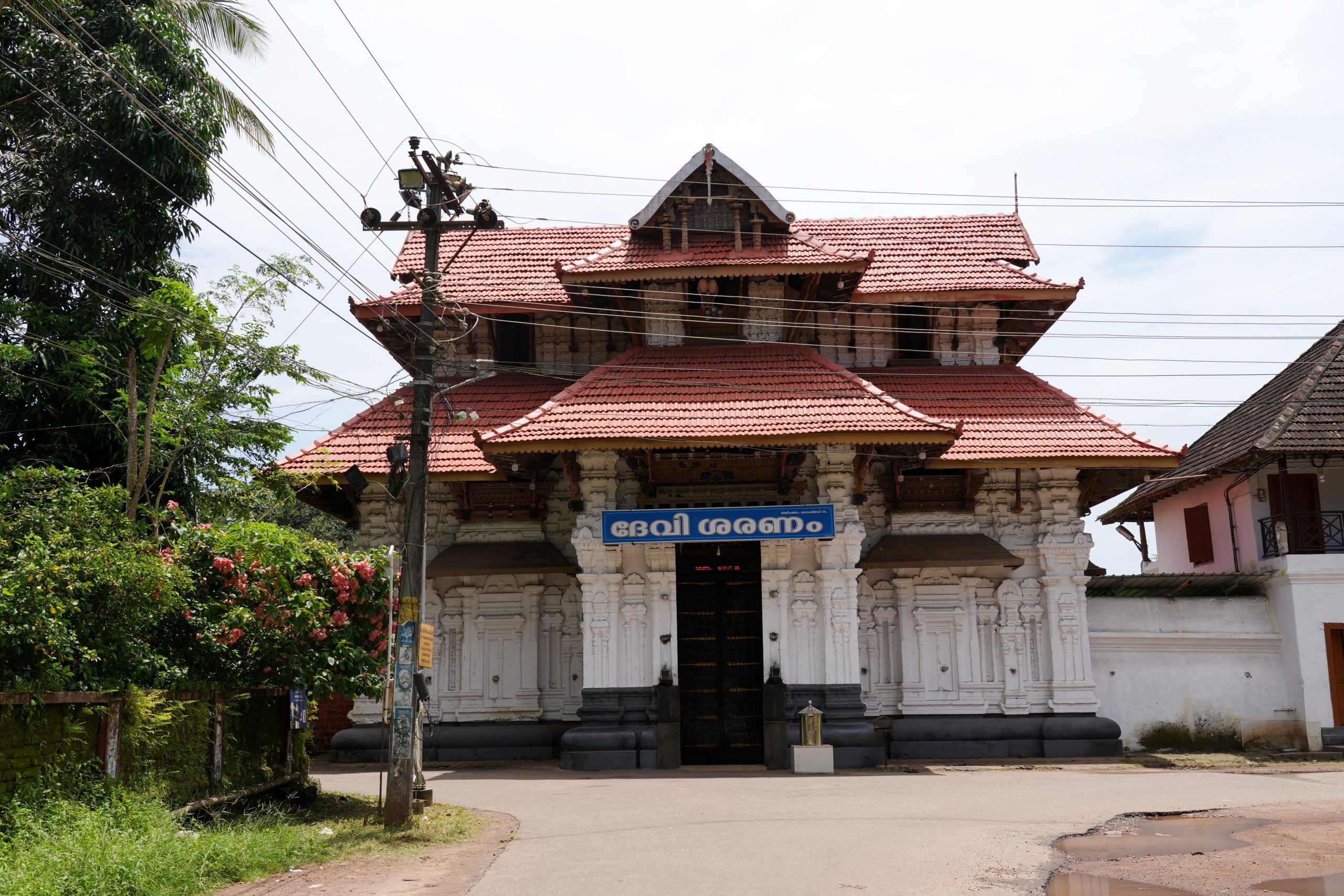
UrakathammaThiruvadi Temple
The renowned “Bhaṣhanaiṣadha Champu,” a masterpiece of classical poetry, was created by the illustrious poet Mazhamangalam. One of its most notable verses is the invocation that begins with “Ambathonnaksharali,” a prayer dedicated to the revered UrakathammaThiruvadi, known as Thirivalayannur Bhagavathi.
The UrakathammaThiruvadi Temple, located in the esteemed Peruvanam village, is one of the 64 sacred villages in Kerala, often referred to as the land of Parashurama. Peruvanam is renowned not only for its grandeur but also as a cradle of knowledge and wisdom. It is in this sacred village that Lord Parashurama settled the noble Brahmins he brought from foreign lands, bestowing upon them the title of Namboothiri and establishing them in this village as their permanent abode.
With a deep desire to bring prosperity and abundance to their land, the devotees were filled with a longing to worship and install the revered Kanchi Kamakshi in their village. Thirivalayannur Bhattathiri, along with Kadalayil Namboothirippad and Komarath Menon, took it upon themselves to fulfil this noble mission. They journeyed to Kanchipuram and devotedly worshipped Jagadeeshwari Kanchi Kamakshi. Their unwavering devotion bore fruit as the Goddess graciously appeared before them. In response to their heartfelt prayers, the Goddess accompanied them to Kerala. Upon arrival, she was ceremoniously installed in the padinjatti (west wing) of Thirivalayannur Bhattathiri’s illam (house), which became the Sree Kovil. Thus, the Goddess came to be revered as Thirivalayannur Bhagavathy, and her divine presence has since been a source of blessing and protection for the land.
The Goddess, revered as Sree Bhagavathy, is meditated upon as the bestower of all prosperity and wealth. Although her form, with four arms holding the conch, discus, Varadamudra, and Amritakalasha, may evoke the presence of Vaishnava energy, the crescent moon on her crown and the lion depicted as her vehicle on the flag suggest the identity of Parvati Devi. When the scholar Uddanda Shastrikal visited Urakam Temple, he worshipped the Goddess as Parvati Devi. Mazhamangalam, a devout follower of Thiruvadi, beautifully captures this devotion in his verse “Ambathonnaksharali,” where he praises the Goddess as the ruler of letters, the granter of wealth, and the bestower of all good fortune.
Though poets and scholars have tried to depict the Goddess in various forms—as Lakshmi, the beloved of Mahavishnu; as Parvati, the queen of Shiva’s heart; and as Saraswati, the consort of Brahma—based on descriptions of her attributes, weapons, and symbols, the devotees hold a different belief. They steadfastly believe that Amma Thiruvadi is a divine virgin, a Kanyaka.
Interestingly, despite her grandeur, the Goddess does not favour fragrant flowers in her worship or adornment. Instead, she has a deep love for golden ornaments, preferring to be adorned in the resplendence of gold.
It is a remarkable and mysterious fact that this divine presence has continued to maintain its grandeur and authenticity through the ages. While Navaratri and Thrikarthika are the main annual festivals, the temple’s most significant events revolve around the tantric rituals that begin on Revathi Day in the month of Meenam. These rituals start with the Vasthu Bali in the evening, followed by the Brahma Kalasham on Rohini day, the flag hoisting on Makiram, the Thiruvathira Arattu, and the Narukkulangara Punartham Arattu. After the Peruvanam Pooram, the rituals continue with the Arattu at Thodukulam, Ayyiril mana, and the Tantri Illams, followed by the Arattu at Pidikapparambu, CheruvathurManakkal, and KeezhottukaraManakkal, culminating in the Arattu at Keezhottukara Kadavu. Finally, the grand Kootiy Ezhunnallippu at Arattupuzha, with the presence of 33 crore deities, sees the Goddess adorned and positioned on the left side of Thriprayar Thevar during the procession and Arattu in the river with the Thevar.
The Brahmani Paattu on Uthram night and the Peruvanam pakal Pooram with its flag-lowering ceremony on Atham mark the conclusion of the most important celebration, Pooram, at the UrakathammaThiruvadi Temple.