
CHITTICHATHAKKUDAM SREE DHARMASHASTHA TEMPLE
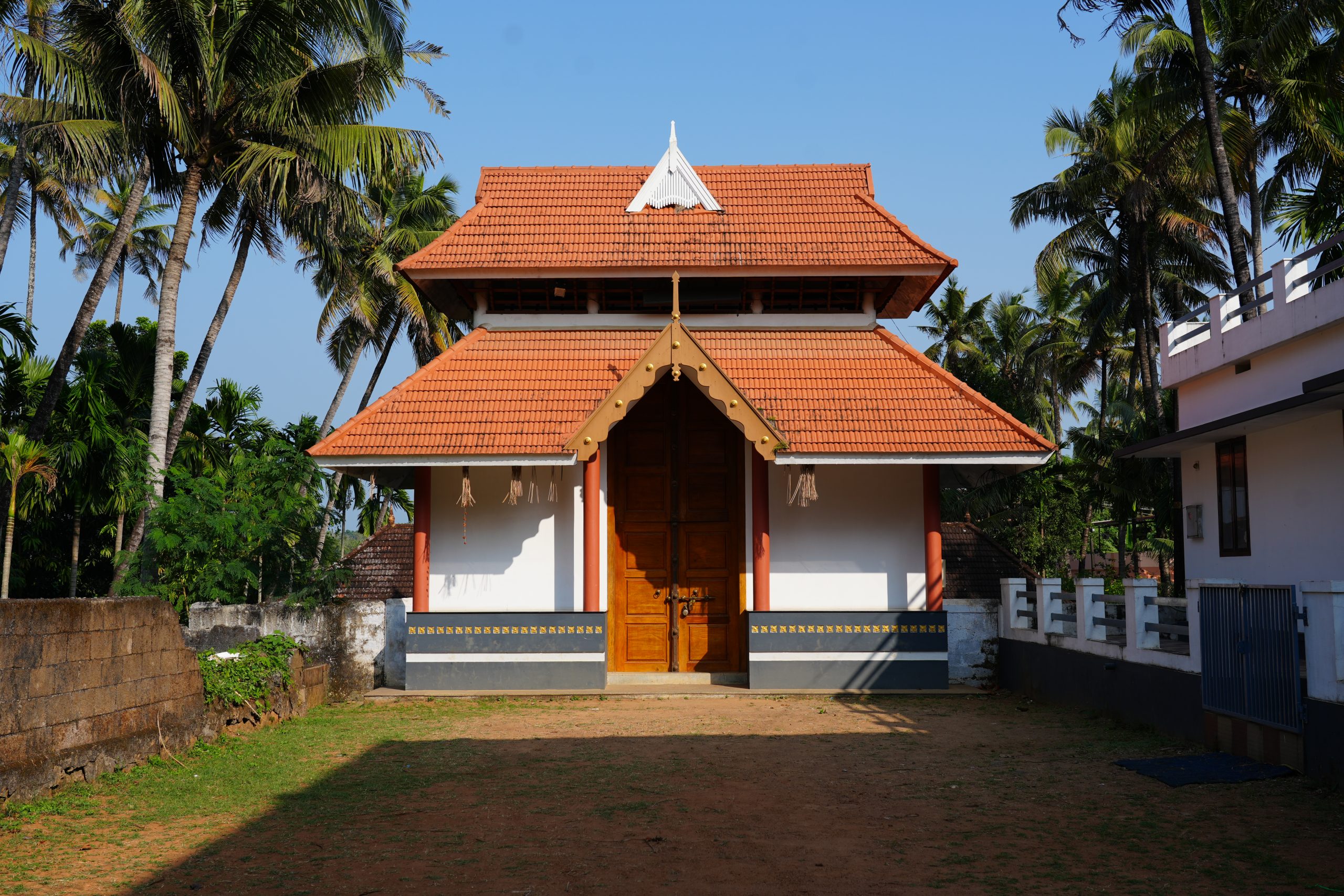
Chittichathakkudam Sree Dharma Sastha Temple, situated half a kilometer west of the Thalore bypass along the edge of a vast paddy field, is an ancient temple in Central Kerala. It stands as one of the oldest temples in the region, potentially older than many others, though there are no definitive records to verify its age. However, the temple’s architectural features, the sanctum sanctorum (Sreekovil) shape, and the wear and tear on the primary idol indicate its antiquity.
The Sreekovil here is unique, designed in the rare Gajaprishta (elephant-back) style, a feature seen only in a few temples. Remnants of murals, once painted on the walls, can still be found in certain places. The idol itself is crafted in a meditative posture, with the left leg extended downward and the right leg bent and resting on the left thigh, with the hands placed on the respective knees. The right hand holds a Satugrama, a symbolic object of significant spiritual value.
According to legend, the deity here is a Satvic form of Sastha, believed to have been consecrated by Lord Rama himself. The idol represents a sage deeply engrossed in meditation. Perhaps this is why rituals involving Rajo Guna (associated with passion and activity) have never been customary at this temple. In a previous Devaprashnam (a ritualistic astrological reading), it was revealed that the deity derives the greatest satisfaction from Vedic worship. As a result, a Vedic ritual known as “Varam” is conducted on the Uthram day of every month. Performing this ritual is believed to be particularly beneficial for those seeking progeny and prosperity.
‘Varam’ Ritual
Varam is performed on the Uthram day during the evening. The first part of Varam is called “VechuNamaskaram.” During this ritual, a lamp is lit and placed in the Mandapam (the main temple hall). Close to the lamp, an Avana Palaka (a wooden plank) is set, on which betel leaves, areca nut, and coins are separately placed. Below the plank, 12 small stones and a freshly washed cloth (mundu) are also laid out. The Ooralan (the temple priest) worships and prays to the deity, touching all the items (stones, cloth, areca nut, betel leaves, and coins) and offering them to the deity. Afterward, the priest performs three prostrations (namaskaram). This ritual is known as VechuNamaskaram.
The second part of Varam is “Palamirikkal.” During this, the Vedic scholars (often more than one) sit in front of the lit lamp and arrange the small stones in a specific pattern. One of the Vedic scholars then touches a particular stone, which indicates which part of the Vedas should be recited. The scholars then chant that portion of the Vedas aloud. If there are more scholars present, they also participate in the recitation. After the recitation, the stones, which were arranged in a specific pattern, are gathered together. The Athazha Pooja (nighttime worship) in the temple is performed only after the Palamirikkal is completed. The third part of the Varam ritual is the Annadanam, a grand feast where devotees are served a sumptuous meal.
One of the major offerings at the temple is “Kayyum KaalumEduthuVekkal,” which involves dedicating representations of hands and feet made of gold or silver to the deity at the temple’s main entrance. This ritual is particularly significant for those seeking relief from rheumatism, as the deity is believed to possess special powers for curing this ailment. Another important offering is “NaazhiPidiyum,” where devotees offer a measure of dry paddy to the deity, praying for the fulfillment of their wishes. In addition to these special offerings, all the common rituals observed in other temples are also conducted here.
Among the annual festivals, the Pratishtha Day, celebrated on the Makiram star in the Malayalam month of Makaram, and the Pooram festival in the month of Meenam are the most significant. On these days, special tantric rituals like Navakam and Sreebhoothabali are performed, along with Niramala (adorning the temple with garlands) and ChuttuVilakku (lighting of lamps around the temple). Apart from these, the temple does not traditionally observe other celebrations or processions. Other annual observances include Vishukkani (viewing of auspicious items on Vishu), Poojavettu (offering during Vishu), 12 days of Bhagavati Seva in the month of Karkidakam, and Laksharchana (chanting of mantras a hundred thousand times).
Pooram
The PeruvanamArattupuzha Pooram festivals involve a series of ceremonies across 24 temples, and this temple is no exception, with almost all the rituals observed here as well. The prominence of the deity in the Pooram festivities is evident from its participation in all the major Poorams. After the flag hoisting (Kodiyettam), daily tantric rituals such as Navakam and Sreebhoothabali are performed until the flag lowering (Kodikkuthu).
The flag hoisting takes place on the Makiram star day. The flag is raised after completing the temple rituals, just before evening. The flagpole is made of areca palm with its head adorned with tender mango and banyan leaves. The ceremonial blowing of the conch three times by the Marar (temple musician) marks the raising of the flag, signaling the commencement of the Pooram season with great enthusiasm. The ritual concludes when the Ooralars (temple custodians) tie Darbha grass to the flagpole.
As in most Shasta temples, the Pooram festivities officially begin on the Thiruvathira star day. After the evening temple rituals, including Navakam and Sreebhoothabali, the Marar sounds the drum (Paani) with the consent of the Ooralars, and the deity is ceremoniously taken out for the Pooram processions. The deity is first taken to Karekkattu Mana for a special puja, and later at 9 PM, proceeds to the Thaikkattussery Pooram. After the procession, the deity rests until the conclusion of Bhagavati’s Pooram the next day. Following Bhagavati’s Pooram, the deity is once again taken out for the Idavazhi Pooram, and after the ceremonial offerings (Upacharam), returns to Chittichathakkudam temple by 2 AM.
In the evening, after the temple rituals, the procession begins with the deity being taken to Paliekara for the ceremonial collection of offerings (Parayiduppu). The procession then proceeds to ‘Tathanappally Mattom’, where the deity is ceremoniously placed for puja. By 10 PM, the deity arrives at Chakkamkulangara Temple and participates in the PunarthamVilakku, positioned to the right of the host deity, Chakkamkulam Shastha. The next morning, after receiving the ceremonial offerings, the deity returns to Chittichathakudam Temple to prepare for the Pooram festivities.
At 7 AM, the deity from Chittichathakudam Temple is positioned near the banyan tree at the western entrance, awaiting the arrival of other deities participating in the Pooram. Once Chakkamkulam Shastha, Thaikkattussery Bhagavathy, and Edakkunni Bhagavathy arrive, they all enter the temple accompanied by the traditional Pandi Melam. The host deity, Chittichathakudam Shastha, is ceremoniously placed on the Avana Palaka in the Mandapam, facing east. The other deities are also positioned on separate platforms according to the main rituals of their respective temples. All four deities are then offered Punyaham (ritual purification) together. Following this, Chittichathakudam Shastha is led into the Sreekovil (sanctum sanctorum).
As the other deities exit the temple, the host deity is ceremoniously escorted outside with drum beats and given the final offering (Upacharam). First, Edakkunni Bhagavathy, then Thaikkattussery Bhagavathy, and finally, Chakkamkulam Shastha offer their respects and depart, marking the conclusion of the Chittichathakudam Pooram. After the temple rituals, Chakkamkulam Shastha joins the procession to Kaplingat Mana for the ceremonial pooja, followed by rest until 4 PM. The procession then heads to Peruvanam Pooram, stopping to collect offerings from Thaikkattussery before arriving at Perumanam Temple at 7 PM for the Pooram celebrations. The deity participates in ‘Vilakku’ ceremony within the temple walls at 1 AM before returning to Chittichathakudam Temple.
The day is spent resting. In the evening, after the temple rituals, the procession heads to Thalore Mahadeva Temple, where Chakkamkulam Shastha and Thaikkattussery Bhagavathy also arrive. After a circumambulation, the deities are ceremoniously placed in the temple for pooja and offerings. The procession continues to Elangalloor Mana, Moothedath Mana, and KadalasseryAvanaav Mana for pooja.
After the Pooram festival at Pidikaparambu and the ceremonial elephant race and offerings, the deity returns to the temple for the day’s rituals, including Navakam and Sreebhoothabali. In the evening, after collecting offerings from Thalavanikkara, the procession heads to Arattupuzha for the Tharakkal Pooram. After the TharakkalPooram, the deity is ceremoniously placed in the temple, followed by the offerings. The deity circumambulates the temple before returning. This journey is to ensure that all preparations for the upcoming Deva Mela are complete.
Following the temple rituals in the morning, at 8 AM, the procession moves to KadalasseryPisharikkal Temple. The deity is ceremoniously placed there, offerings are made, and respects are paid. Then, together with the deities from Chathakudam, Chittichathakudam, Arattupuzha, Pisharikkal, and Thaikkattussery, the procession proceeds to Thottippal for the Pooram festival. After the Thottippal Bhagavathy’s Pooram concludes, the deities from Chittichathakudam, Thaikkattussery, and Pisharikkal stand at the Vishnu Temple on the northern side. After the Bhagavathy’s Pooram, the deities are led inside, and those from Chittichathakudam enter the sanctum sanctorum. After the offerings, the three deities depart.
After the Pooram, the procession moves to KezhottukaraKadalayil Mana and Chorinjedathu Mana for the ceremonial poojas, then returns to Arattupuzha Temple in the evening. After the Deva Mela and offerings, the deity returns to Chittichathakudam Temple by 11 AM the next day.
After returning from the Arattupuzha Pooram, the temple rituals are conducted, marking the conclusion of the tantric ceremonies. In the evening, offerings are collected from Nanmanikkara and the poojas are performed at Vatakkiniyedathu and PallatheryIllams. The procession then moves to Edakkunni Temple to participate in the UthramVilakku festival, where the deity is positioned to the right of Edakkunni Bhagavathy as the second deity in the procession. After the Vilakku and the subsequent street processions and offerings, the deity returns to Chittichathakudam Temple. On this day, there are no morning rituals at the temple.
In the evening of Atham day, the Niramaala and ChuttuVilakku (lamp-lighting ceremony) take place. The deity is then ceremoniously led outside, accompanied by the sound of drums (Chempada) to the west, where the procession halts at the sacred banyan tree. Following this, the procession turns eastward and continues with three elephants leading the way. The celebration includes traditional performances such as Keli, Kombupattu, and Kuzhalpattu, followed by the grand Panchari Melam within the temple compound. After the Panchari Melam, the deity is carried around the temple seven times, and the final ceremony concludes with the lowering of the flag, marking the end of the Pooram festivities.
Chittichathakudam is a private temple under the control of the Cochin Devaswom Board. The temple is managed by four Illams (traditional Namboothiri houses): ChittisseriMoothedath Mana, Kappalangat Mana, ArattupuzhaChorinjchettathu Mana, and KallurAvanoor Mana. A committee composed of these Uraymas (temple custodians) and local residents currently oversees the temple’s administration. The temple’s tantric rituals are conducted by priests from the Elangallur Mana and KainikkaraVadakkeedathu Mana. The daily rituals are carried out with the support and cooperation of the local community. Additionally, for the Pooram festival, the central committee provides significant assistance alongside the local contributions.