


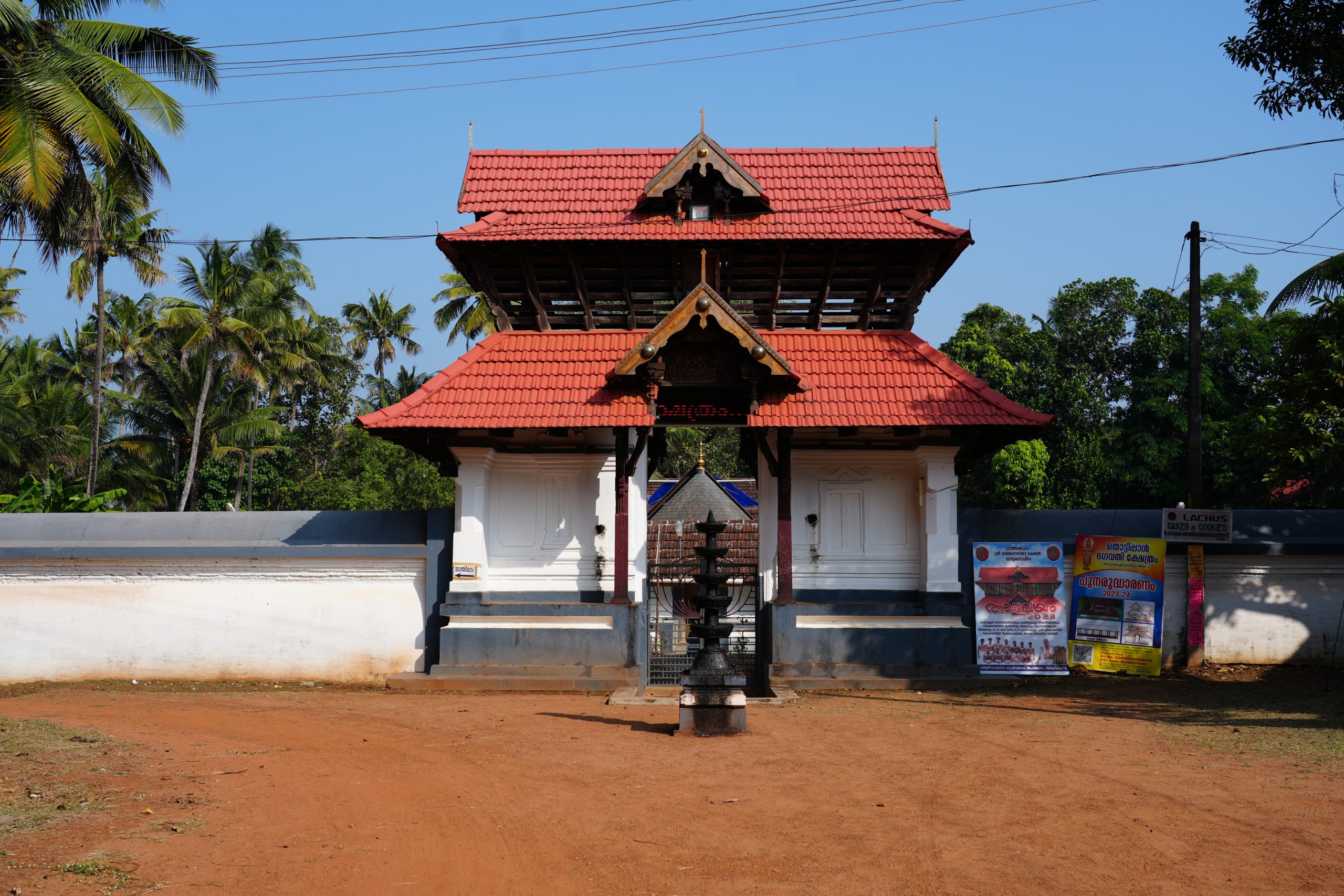
CHATHAKKUDAM SREE DHARMASHASTHA TEMPLE
The Sri Dharmasastha Temple, located in the village of Chathakkudam in Vallachira, is one of the prominent ancient temples in the Peruvanam region, just 15 kilometers from the cultural city of Thrissur. The temple is situated 3 kilometers east of Puchinnipadam, along the Thrissur-Kodungallur route, and 4 kilometers west of NH 47 at Paliyeekkara.
According to the AshtamangalaPrashnam, a traditional astrological consultation, the Chathakkudam Temple is estimated to be around 2,180 years old. A significant piece of evidence supporting this claim is the vattezhuthu inscription carved on a stone slab beneath the steps of the sanctum sanctorum. Despite extensive research, the true meaning of this ancient script remains undeciphered, further emphasizing the temple’s deep historical roots and its connection to an era long past.
The arrival of Lord Sastha to Chathakkudam is shrouded in two intriguing legends, as passed down by the elders. One of these stories tells of how the idol was brought from the Thiruvullakavu Temple. According to this tale, two prominent families from the Peruvanam village, the Chittoor Avanav and the VallachiraAvanav, eventually found themselves at odds, leading to a rivalry. Due to this, the VallachiraAvanav family was not allowed the honor of worshipping Lord Sastha at the Thiruvullakavu Temple, which was under the influence of the Chittoor Avanav family.
In response, the VallachiraAvanav devised a plan. They sent a man from the ChathanPulaya community, who managed to outwit the Chittoor Avanav under the cover of ritual and stealthily transported the Thiruvullakavu Sastha’s idol to Chathakkudam. The idol was hidden in a pot, covered with leaves, hence the name “Chathakkudam,” meaning “brought by Chathan in a pot.”
One undeniable fact is that there is no idol at the Thiruvullakavu Temple today, and the similarity between the deities of Thiruvullakavu Sastha and Chathakkudam Sastha is striking. This resemblance supports the legend. Moreover, during the Arattupuzha Pooram festival, it is a long-standing tradition to ceremoniously bring the Thiruvullakavu Sastha to Chathakkudam, where both idols are worshipped simultaneously on the same pedestal. The two Sasthas are also taken together on the same elephant for the Gramabali ritual, where offerings are made throughout the village. This enduring practice lends credence to the ancient legend, reflecting the deep cultural and spiritual connection between the two temples.
Another legend suggests that Lord Sastha originated from the nearby Pidikkaparambu Shiva Temple. It is said that Lord Shiva, deeply absorbed in listening to sacred chants, never seemed to tired of them. However, Sastha, considered Shiva’s son, couldn’t bear the constant chanting. Frustrated, Sastha eventually rebelled against his father and jumped into the Pidikkaparambu temple pond. From there, he is believed to have journeyed through the Chemeen Kayal and Chapa Kayal waterways, eventually settling at Shasthamkol.
He then made his way to the nearby Chapakudam Temple, where the presiding deity was Bhagavathy. Upon Sastha’s arrival, Bhagavathy graciously moved to a subordinate position, giving Sastha the primary place of worship. Over time, Chapakudam Sastha became known as Chathakkudam Sastha, a transformation steeped in the local lore passed down through generations.
Chathakkudam Sree Dharma Sastha Temple is situated on an expansive piece of land, enclosed within massive, elephantine boundarywall. At the center of this grand complex stands the Sreekovil (sanctum sanctorum), which is adorned with ancient and intricate carvings, uniquely designed in the shape of an elephant’s back. Surrounding the Sreekovil is the Chuttambalam (outer structure), and to the east and west are two large gateways, designed to allow elephants to enter the temple grounds.
The western side of the temple features a spacious pathway, wide enough for seven elephants to line up during grand festivals like the Pooram. To the east, there is a pathway leading to the temple pond, equipped with an elephant ramp for bathing the elephants. Although the main entrance is on the western side, the deity, Lord Sastha, faces eastward.
On the southeast side of the temple complex, there is a special platform known as the Nilapadu Thara, which is used for placing Lord Sastha atop an elephant during the Pathamudayam festival.
Interestingly, although there were plans to construct a grand Vilakkumadam (lamp pavilion) outside the Chuttambalam, this project was never completed, and the reason for its abandonment remains a mystery to the current generation.
Thiruvullakkavu Sastha is renowned for enhancing intellectual prowess, while Chathakkudam Sastha is revered as a divine healer for those afflicted with rheumatic ailments. There’s an interesting legend that speaks to this. Many years ago, a man from the southern region, suffering severely from rheumatism, heard about the extraordinary powers of Sastha and came to the temple seeking relief. Unable to walk, he would drag himself around the temple in devotion, performing pradakshina (circumambulation) for nearly a year.
One day, as he was completing his ritual, a tiger suddenly leaped towards him. In terror, he cried out, “Oh no, a tiger!” and miraculously stood up and ran. Hearing his cries, people rushed to his aid, but no trace of the tiger was found. In fact, no one had ever seen a tiger in that area before or after the incident. However, the man’s rheumatism had vanished, and he fulfilled his vow by donating funds to build the massive protective wall around the temple.
Even today, oil infused with herbs is offered to Sastha to cure rheumatism, and many devotees have testified to experiencing miraculous healing. Offering ‘Ada’ (a traditional rice cake) at this temple is believed to bring about the fulfillment of desires and cure diseases. Sastha is indeed a source of divine joy for those who believe, but it is said that he grants this bliss only after putting his devotees through rigorous trials.
When discussing the significance of the presiding deity at Chathakkudam Temple, it is important to note that the idol of Sastha here stands out as unique compared to other Sastha idols in various temples. The posture of the idol, where the left leg is grounded with the knee bent and the right leg is raised, supported by the left hand resting on the knee and the right hand on the thigh, evokes the image of the great sage Vishwamitra. This distinct posture serves as another testament to the temple’s ancient heritage.
The daily rituals at this temple have always been conducted with the utmost discipline, befitting a grand temple. Historically, the temple owned extensive lands, which contributed significantly to its upkeep. However, with the implementation of the Land Reforms Act in 1970, these lands were seized under legal provisions, leading to severe financial difficulties for the temple’s caretakers, the Ooralans. This unfortunate situation forced the temple’s management into a state of decline, with the temple surviving solely on the support of the local community through a temple protection committee for some time.
To ensure the temple’s continued existence and proper management, the Chathakkudam Temple, along with its subsidiary temples—Vallachira Bhagavathi Temple, Chittengara Devar Temple, Kandeswaram Shiva Temple, and Kurumbilavu Temple—were eventually entrusted to the Cochin Devaswom Board. Although the Pidikkaparambu Shiva Temple was also part of this group, the temple’s caretakers expressed reluctance to hand over control to the Devaswom Board at that time.
The esteemed tantric lineage of the Chathakkudam Temple is shared equally among three prominent families: the Thekkedath Perumpadappu, the Vadakkedath Perumpadappu, and the KainikkaraVadakkedam households. These families hold equal representation and responsibility in the temple’s spiritual and ritualistic affairs.
In 1994, following the recommendations of the AshtamangalaPrashnam, several significant additions were made to the Chathakkudam Temple. Inside the Nalambalam, new idols of Ganapathy, Shiva, and Chappa Bhagavathi were consecrated, along with the existing Thekkan Thevar (Vishnu idol). Additionally, new idols were installed for the Mother Goddess at Cherukunnu. The temple celebrates its Prathishta Day on the day of Pooyam star in the month of Kumbham.
The grand gathering of deities at Arattupuzha in Peruvanam village, a major highlight of the Pooram festival in the month of Meenam, is set into motion by the flag hoisting at the Thiruvullakkavu Sri Dharma Sastha Temple on Uthram day in Kumbham. This marks the beginning of the Pooram season, where the Chathakkudam Sastha plays a crucial role. However, it is questionable whether the current generation fully appreciates the deep significance of these ancient rituals and the important responsibilities carried out by the Sastha during this time.
With the flag hoisting on the day of Makiram in Meenam, the Pooram festivities for Chathakkudam Sastha officially commence. On Thiruvathira, the Sastha sets out for the Pooram celebrations, an event famously known as the “ThiruvathiraPurappadu.”
On the evening of Thiruvathira, around 7 PM, the Thaikkattussery Bhagavathi and Chakkamkulangara Sastha arrive at the Chathakkudam Temple to participate in the Pooram festivities. They ceremonially lead the Sastha out, marking the beginning of the grand “ThiruvathiraPurappadu.” In the western courtyard of the temple, accompanied by the presence of Thaikkattussery Bhagavathi, Chakkamkulangara Sastha, and seven majestic elephants, the Panchari Melam rhythmically fills the air, celebrating this auspicious event with grandeur. After the ceremonies, the Sastha proceeds to Avanav Mana for the traditional Izhakkipooja, and early on Punartham day, heads to EdakkunniThekkinayidath Mana for another Izhakkipooja, followed by the “Chaal Idukka” ritual at Marathakkara.
After the rituals at Kandeengayi, the Sastha arrives at Thaikkattussery Pooram around 11 AM, participating in the festivities. Upon returning in the evening, Arattupuzha Sastha, Pisharikkal Bhagavathi, and Thottippal Bhagavathi arrive at the temple to invite the Sastha to their respective Poorams. Notably, Thottippal Bhagavathi is seated on the Sastha’s pedestal and then led out in a grand procession. After honoring the Arattupuzha Sastha and Pisharikkal Bhagavathi, and accompanying Thottippal Bhagavathi on a circumambulation, the Sastha bids farewell to Thottippal Bhagavathi.
Later, around 9 PM, the Sastha ceremoniously departs to guard the sacred Arattu of UurakathammaThiruvadi at Narukkulangara, and around 1 AM, after the Arattupuzha Sastha departs from Narukkulangara, UurakathammaThiruvadi also begins the journey back. The Sastha then proceeds to Chakkamkulangara for the Vilakku ceremony and returns to Chathakkudam by 8 AM on Pooram day. In the evening, the Sastha sets out for the Peruvanam Pooram, ceremoniously received at Narukkulangara and Thottippal Bhagavathi to the left, while leading a majestic procession with seven elephants in a grand Pancharimelam. After the Pooram, the Sastha bids farewell to Thottippal Bhagavathi and then participates in UurakathammaThiruvadi’s Pooram.
After the festivities, the Sastha, accompanied by UurakathammaThiruvadi, proceeds to Peruvanam Temple, where they are ceremonially welcomed before heading to Thodukkulam for the procession. Once the Cherpu Bhagavathi’s Pooram concludes, the Sastha departs for Urakam Temple, where Thottippal Bhagavathi is formally sent off. On Ayilyam day, when Urakathamma is led out for the Siveli, the Arattupuzha Sastha offers respects first, followed by Chathakkudam Sastha, before they part ways. The Sastha then returns to Chathakkudam Temple and around 10 PM, departs for the Pooram at Pidikkaparampu. After circumambulating the Pidikkaparampu Temple, the Sastha pauses at the Kallu Palam in the paddy fields, where the Vilakku ritual is performed before returning to Pidikkaparampu Temple for the Irakkipooja. Meanwhile, UurakathammaThiruvadi arrives at Chathakkudam Temple, warmly received by devotees with offerings.
On the morning of the Makam day, around 7 AM, Sastha takes his stand as the principal deity of the Pidikkaparampu Pooram, positioned majestically facing west on the grand embankment in the fields. This Pooram, revered as the “Palli Vetta” of the Peruvanam festival, continues to be celebrated with great tradition and reverence even today.
When Cherpu Bhagavathy circumambulates the Pidikkaparampu Temple, Chathakkudam Sastha accompanies her until EzhuKandom and bids farewell. Following this, after the Kombu Pattu and Kuzhal Pattu performances, Sastha escorts OorakathammaThiruvadi to EzhuKandom and respectfully bids farewell. Witnessing all of this, the Arattupuzha Sastha stands facing north on the southern side of the paddy fields. The Nettissery Sastha, along with the Bhagavathis from Thaikkattussery, Edakkunni, Thottippal, and the Sashthas from Chakkamkulam, Chittichathakkudam, Medamkulam, Nankulam, and Kodannur, also partake in the Pooram festivities and the Palli Vetta, which involves an elephant race. After paying their respects to Sastha, they depart. Arattupuzha Sastha then circumambulates the temple, offers respects, and bids farewell.
Chathakkudam Sastha, symbolizing Thriprayar Thevar, offers three rounds of respect before returning to Chathakkulam. Next day morning around 4 PM, Sastha crosses the eastern gopuram, faces east, and blows the Pattini Shanku (sacred conch). Then goes to Pazhayi to receive Para at Koppadanmar. Following this, Sastha is carried to Kadalayil Mana at Thekkedathu, where poojas are performed and the locals greet him with tender coconuts. By 6:00 AM, Sastha is taken to Kadalayil Mana at Keezhottukara for poojas and then to Pisharikkal Temple for another procession.
By 11 AM, after paying respects to Pisharikkal Bhagavathy, Sastha collects offerings from Karoli Mana and proceeds to Thottippal Pooram. After the Pooram celebrations, when Sastha returns accompanied by the sound of the melam (traditional music), the locals welcome him by breaking coconuts. Sastha is then seated on the deity’s pedestal at Thottippal Temple, where Brahmani Amma sings the Bhagavathi song.
In the presence of other deities, the Sastha’s Shantikaran (priest) ties a string around the wrist of Bhagavathy’s Shantikaran. After offering respects to the other deities, Sastha and Bhagavathy together take a circumambulatory walk around the temple. During the second circumambulation, Sastha offers respects at specific points: two on the south side, two on the west side, and two on the north side before the ovate room is opened. Sastha also touches the tails and tusks of the two elephants, completing the rituals with devotion and reverence.
These rituals culminate with Chathakkudam Sastha joining Arattupuzha Sastha outside the temple and proceeding together to Arattupuzha Temple. After the procession and rituals at Arattupuzha, Sastha grants permission for the Arattupuzha Pooram to commence, offering his respects before parting ways.
Upon returning to Chathakkudam, Sastha sets out again at 9 PM, making his way from ArattupuzhaShasthamkadavu, accompanied by the sound of the Chempada drums. Alongside Thottippal Bhagavathy, the Pooram celebrations reach their peak at the Thevar Varambu. Afterward, Chathakkudam Sastha takes over the position of honor from Arattupuzha Sastha.
When Thriprayar Thevar arrives, Chathakkudam Sastha participates in the grand procession with Oorakathamma, and together they proceed to Mandaram Kadavu. There, they disembark at the ceremonial mandapam (platform) for the Arattu (holy bath). Once Thriprayar Thevar concludes the Arattu at Mandaram Kadavu, Chathakkudam Sastha returns to Chathakkudam Temple, marking the end of these elaborate and sacred rituals.
At the Arattupuzha Pooram, until the arrival of Thriprayar Thevar, the position of honor belongs to Chathakkudam Sastha. It is significant that the Pooram of Chathakkudam Sastha concludes at Thevar Varambu, and during the grand procession, Sastha is positioned on the left side of Thevar and the right side of Oorakathamma. The ceremonial invitation extended by Arattupuzha Sastha to Chathakkudam Sastha to join the festivities at Arattupuzha underscores the irreplaceable significance of Chathakkudam Sastha’s presence. This not only highlights Sastha’s vital role but also affirms the position of Chathakkulam Sastha as a prominent figure, emphasizing his undeniable authority and reverence within the ceremonial hierarchy.
On the day of Uthram, around 6 PM, an elephant and other ceremonial paraphernalia are sent from Chathakkulam to escort the Thiruvallakkavu Sastha out, led by the priest from Chathakkudam. This ceremony is a reenactment, honoring the legendary account of how the Thiruvallakkavu Sastha was originally brought to Chathakkudam. At KadalasseryAvanavu Mana, a ritual worship is performed for the Thiruvallakkavu Sastha, after which the procession returns to Chathakkudam, where the Chathakkudam Sastha, leading the procession, welcomes the Thiruvallakkavu Sastha. The Thiruvallakkavu Sastha is then ceremoniously placed on his own pedestal within Chathakkudam temple. Following this, rituals like Navakam, Puja, and Sreebhoothabali are conducted. Both deities are then brought to the NadappuraThinnai (temple hall) and positioned together.
After this, a grand procession, marked by the beating of the traditional ‘Pani,’ takes place, where both deities are mounted on the same elephant and proceed to the Peruvanam village to perform the Gramabali. The procession passes through locations such as Pidikaparambu and Oorakam, culminating in front of the PeruvanamIrattayappan temple, where the final offerings are made. The ceremony concludes with the two deities being taken to Thodukulam at Peruvanam, where they are ceremoniously bathed and worshipped at around 5 AM the following morning.
On the day of Atham, around noon, the Pisharikkal Bhagavathy, Oorakathamma, and the two Sasthas proceed together on an elephant to perform the Pooram within the eastern walls of the Peruvanam temple. First, the Pisharikkal Bhagavathy offers her farewell respects and departs, followed by Oorakathamma. The two Sasthas then head towards Thiruvullakkavu, where they are warmly welcomed with traditional offerings and rituals. Once Pisharikkal Bhagavathy departs after her ceremonial farewell, the two Sasthas are ceremoniously placed on the same pedestal within Thiruvullakkavu temple. Following this, the Chathakkudam Sastha performs the ceremonial act of “Kodikkuthal” (hoisting the flag) at the Thiruvullakkavu temple.
After the flag hoisting, the Chathakkudam Sastha returns to Chathakkudam, where, at the Nambiar Madham, the ritual of “Parayedu” is carried out. The Sastha is then carried in a grand procession, with drumming, around the temple 11 times before being ceremoniously positioned. The final act of the ceremony, the “Kodikkuthal” (lowering the flag), is performed, marking the conclusion of the Pooram-related rituals of the Chathakkudam Sastha.