


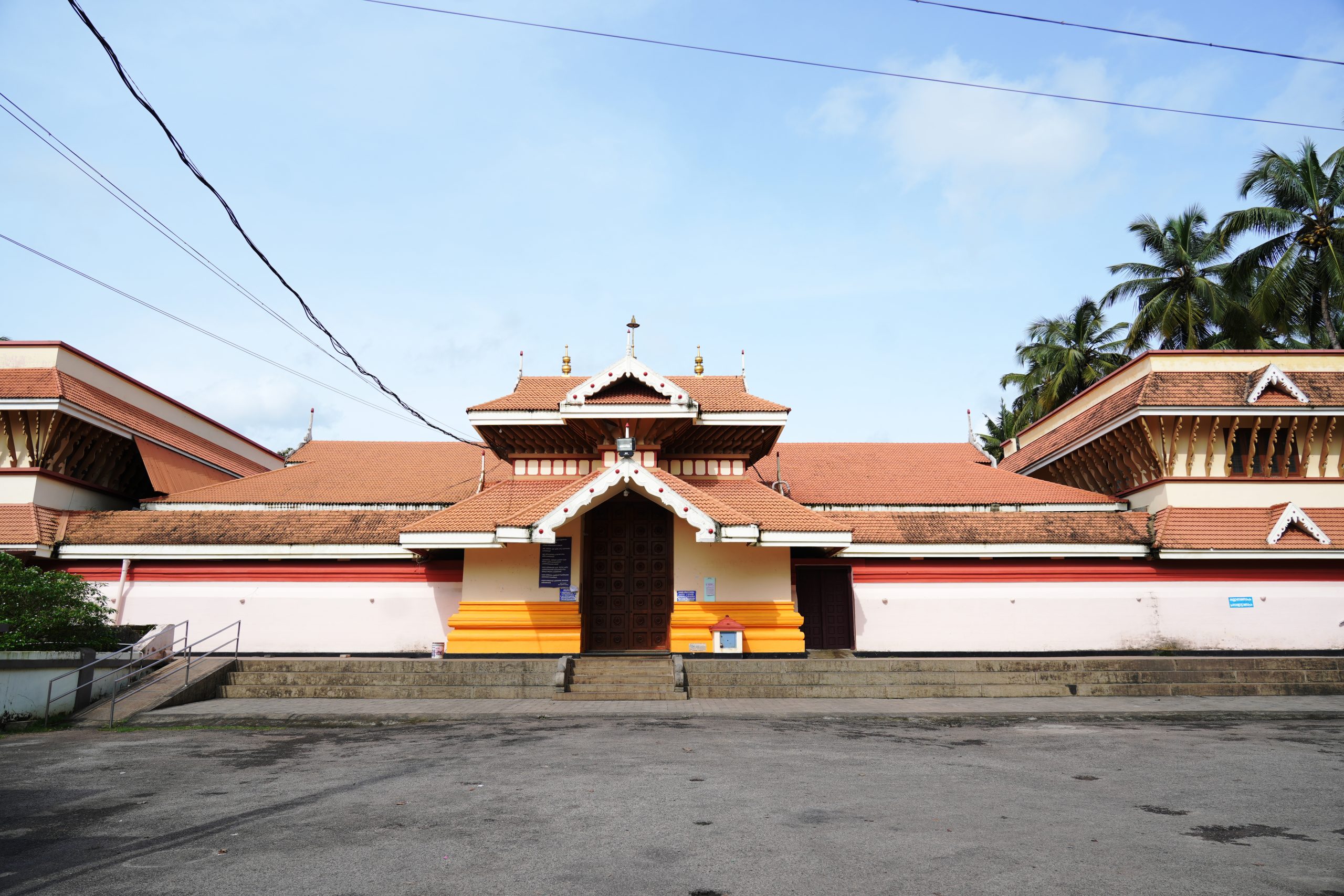
THIRUVULLAKKAVU SASTHA TEMPLE
Thiruvullakkavu is a prominent Sastha temple located in Peruvanam village. This region was once a dense forest, and it was believed that the Sastha here protected the locals from wild animals. Legend has it that when VilwamangalamSwamiyar once visited the temple, he witnessed Sastha being tenderly lifted and embraced by Peruvanam Irattayappan (a deity) with his right hand. The temple’s name, originally “ThiruvallamKaiyyur,” later evolved into “Thiruvullakkavu.” Sastha is revered here as the deity who fills one with wisdom and knowledge. It is believed that even ordinary people have gained wisdom by worshiping this deity, which is why the temple is also considered to have the presence and influence of Goddess Saraswati. For generations, devotees have come to this temple seeking the blessings of knowledge. The deity worshiped here is a self-manifested stone. In the early days, the temple was known as “Nana Sastha,” and a proper roof was only constructed during the time of the Mazhamangalam.
The temple has three daily poojas (rituals). The offerings of Thrimadhuram and Saraswatham Neyyu (ghee) hold great significance here. It is believed that lighting an ‘Elluthiri’ at the temple helps alleviate the effects of Shani (Saturn). For progress in education, it is a custom to offer ‘Navum Narayavum’ in this temple. The practice of ‘Ezhuthiniruthal’ (initiating children into writing) is also significant here. Except for the days of Mahanavami and Uthram in the Malayalam month of Meenam, the temple offers this.
When the Ulsavam at the Peruvanam temple was interrupted a long ago, its rituals were conducted at this village temple, Thiruvullakkavu. As part of the Arattupuzha Pooram, the first flagpole is erected at Thiruvullakkavu temple. On the same day another flagpole used to be erected on the northern side for Temple for Ayunnu Bhagavathi. (But now, that practice ceased). On the day of the Peruvanam Pooram, the Sastavas from Nettissery and Nankulam visit the temple. On the evening of Uthram, the officials from the Sastha Temple at Chathakkudam arrive at the Thiruvullakkavu temple. As the Thiruvullakkavu Sastha is brought out in a procession, the PattiniShankhu is sounded. After the deity is brought to the Avanav Mana for the Irrakki Pooja, the procession continues to the Chathakkudam Sastha temple. Both deities are then paraded, and after the Sheeveli ceremony, they are placed on the same pedestal. The rituals of Navakam and Sreebhoothabali are performed, followed by an Irrakki Pooja at the steps of the temple hall. With the approval of the head priest (Thanthri), the deities are then taken on an elephant for the Grama Bali ritual.
The Grama Bali (offering for the well-being of the village) is performed at significant locations like the sacred tree (Uttama Vriksha), water body, and temple sanctuary. This ritual is carried out at the temples of Pidikkaparambu, Pisharikkal, Thottippal, Mulangu, Arattupuzha, and Peruvanam, concluding at the ValiyaBalikkallu (sacrificial stone) in Peruvanam. After offering (the Bali) at the Peruvanam temple, the Thiruvullakkavu Sastha, along with the Chathakkudam Sastha, is taken for the final Pooja at Thodukulam. The deities participate in the day’s Pooram procession at the Peruvanam temple. When they reach the northern side, the Pattini Shankh is sounded. Following this, the Thiruvullakkavu Sastha returns to the Thiruvullakkavu temple and presides over the Pooram festivities. After the Pooram, nine circumambulations are performed, followed by the Irrakki Pooja. On the same day, the Bhagavathis of Cherpu and Aykunnu arrive at the temple and complete one circumambulation. During this circumambulation, the elephants gently touch the flagpole as part of the ritual.
Appendix
“Virakeduthanvira
keduthu
virakeduthu;virakeduthu”
When one thinks of the Thiruvullakkavu Temple, the phrase “Virakeduthanvirakeduthu, virakeduthu; virakeduthu” is what often comes to mind. This line is famously attributed to Pattath Vasu Patteri, also known as Yamakapatteri due to his extraordinary skill in effortlessly employing yamaka (a poetic device of repetition).
Vasu, known to be slow-witted since birth, had a slight speech impediment, and was often mocked as “Vathu” (a shortened form of Vasu). One day, his friends took him out to play in a boat. Lacking strong swimming skills, they capsized the boat and swam to safety, leaving Vathu behind. By sheer luck, he didn’t drown and eventually, as night fell, he managed to reach the shore, shivering and cold. He stumbled upon the Thiruvullakkavu temple in his search for shelter. Inside the temple, there was a bunch of plantains offered as an offering, and the temple was not yet locked for the night. He found his way into the temple kitchen (thidappalli) and lit a fire using some firewood he found to warm himself. Soon, he was also troubled by hunger. In the light of the fire, he saw a bunch of plantains that had been offered. He ate all of them, satisfying his hunger, and then fell asleep.
The next morning, when the temple priest arrived, he found Vathu in the kitchen with no sign of the firewood. The priest asked, “Where is the firewood?” Vathu, quick-witted as ever, responded with the famous phrase, full of yamaka: “Virakeduthanvirakeduthu, virakeduthu; virakeduthu”. The priest was stunned by the clever wordplay. The line plays on the word viraku, meaning both “firewood” and “cold”. It means: “I took the firewood (viraku) to extinguish the cold (vira), and in doing so, extinguished the firewood itself.”
The priest, slightly astounded, understood the humor and the wit in Vathu’s response. Realizing the deeper meaning, the priest, who was somewhat knowledgeable, pondered and then followed suit by eating the remaining banana peels. This event earned Vathu recognition as a master of yamaka.
The Thiruvullakkavu temple has long been a place where nampoothiris (priests) would come to chant and study the Vedas. Before performing the sacred Othu ritual, it was customary to offer prayers and make offerings at this temple. Even children, until they are around five or six years old, are brought to this temple as well as the Peruvanam temple for regular prayers. Additionally, before finalizing an engagement, especially before the girl sees her prospective groom, offerings are made, such as the sacrifice of twelve cocks (or whatever is possible).
If a child is delayed in speaking properly as they grow, offerings such as placing the tongue and narayam (a writing instrument) at the temple and offering plantains are commonly observed rituals.
In many households, important rituals are carried out by placing money in a lamp as part of the “Kriya Sthanam” ritual dedicated to Lord Shasta.