


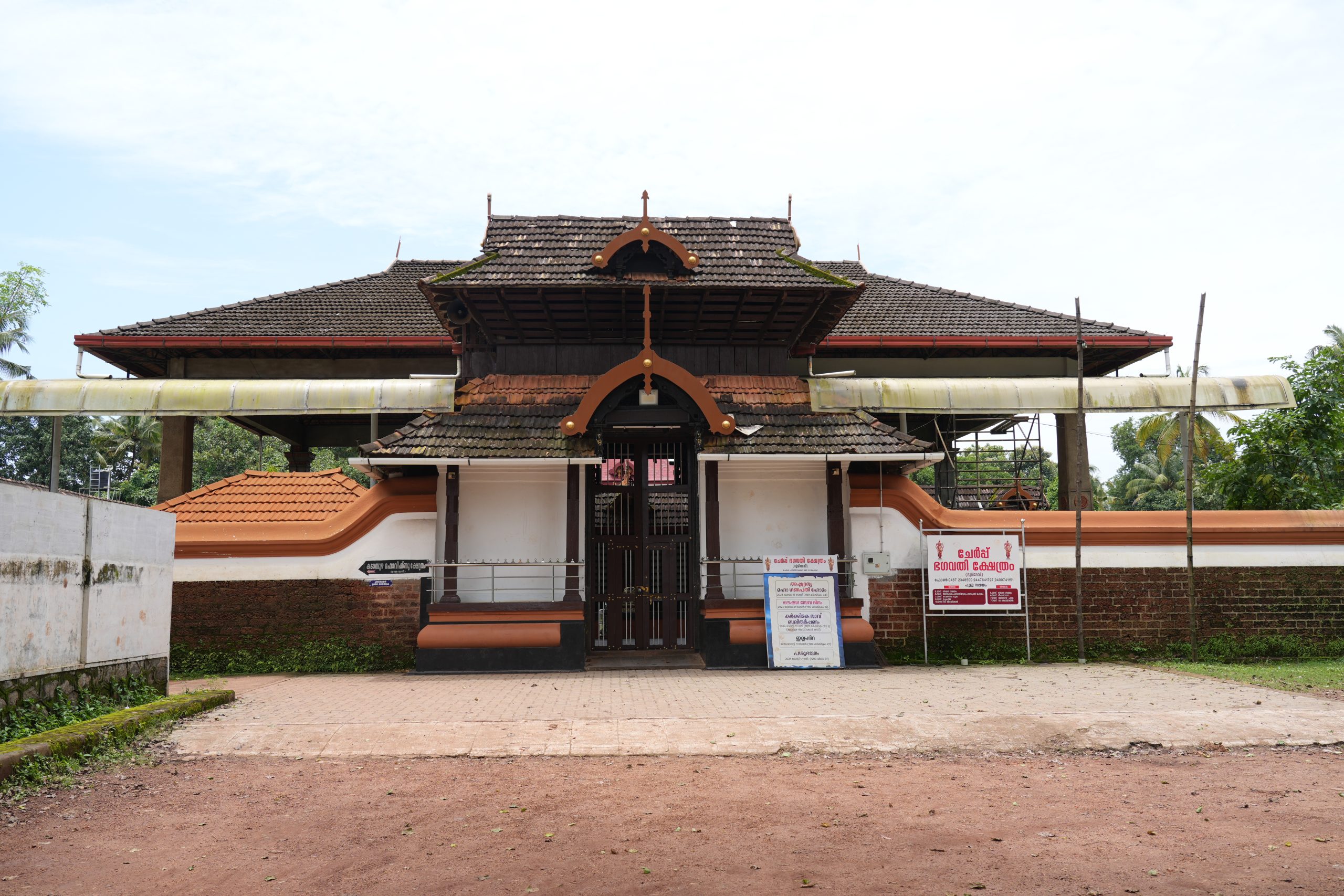
CHERPPU BHAGAVATY TEMPLE
The Cherpu Bhagavathi Temple, one of the 108 Durga temples established by Parasurama, holds significant importance. It is located 13 kilometers southwest of Thrissur on the Thrissur-Thriprayar (via Palakkal-Cherpu) route. The presiding deity, the benevolent Devi, is regarded as the family deity for many families in the Peruvanam village. This temple, rich in historical legacy, continues to shine a light on its former glory.
During the Mandala season, there is a daily procession with the deity, accompanied by traditional musical instruments (Shiveli), which lasts for 40 days. The temple is as ancient as the Peruvanam Temple. The temple also observed the Othoott festival, which lasted for a month. The Prathishta Dinam (consecration day) is celebrated on the Anizham day in the month of Mithunam.
It is believed that offering Neypayasam (a sweet rice dish) continuously for at least three months, starting from Thiruvonam day, will bless devotees with a good life partner. To ensure a prosperous and blessed marriage, it is considered auspicious to perform the Paatt (a special ritual) on the Thiruvonam day in the month of Thulam. On the first day of the Malayalam month of Chingam, cows are ritually presented at the temple for blessings. Performing nine circumambulations around the temple on a Friday is believed to bring prosperity.
The temple was historically under the guardianship of the Chittoor, Padinjaredath, Ambalapilly, Pazhedom, and Kiranngad Illams. Currently, the temple is managed by a committee of local residents known as the Cherpu Bhagavathi Temple Welfare Committee. The close relationship between the Chittoor Mana and the Zamorin family is exemplified by the presence of the Thaliyilappan (Vishnu) Temple. This temple, along with the Kadampuzha Temple to the north, function as subordinate temples.
The main festivals celebrated at the temple are the Vavarat in the month of Thulam and the Thiruvonam Paatt. Vavarat is observed during the fourth phase of the waxing moon (Karanam) in the dark fortnight. On this day, a procession is held, with the deity carried on an elephant. The procession circumambulates the temple twice before stopping at the large banyan tree by the temple pond, where the “Pattinisankh” ritual is performed. Before the procession begins, the Marar (temple musician) blows the conch nine times. For each of these three sets of three blows (3, 6, 9), the temple guardians (Urali Makkar) perform a ritual by striking their left hands with their right hands.
The procession then proceeds to the Mekavu Bhagavathi Temple, where the deity is received with the Nadapandi (traditional drum performance). The procession continues to the eastern gate of the Peruvanam Temple, where it is welcomed with musical performances such as Keli, Kuzhalpattu, and Kombupattu. The deity is then carried down the pathway (Nadavazhi) and taken to the Thodukulam pond for the ritual bath (Arattu). After the Thantri (chief priest) performs the pooja, the deity is placed back on the elephant for the procession. The deity is then carried back to the temple, where it circumambulates the shrine once before being placed back in the sanctum.
Thiruvonam Paatt
The Paatt ritual is performed on the day of Thiruvonam, during the late hours of the night. The central area of the Valiya Ambalam (main temple hall) is adorned with decorations made of Kuruthola (tender coconut leaves) and Pattu (traditional cloth), and a platform is set up in the Paattambalam (a designated area within the temple). The deity is ceremonially led into the Paattambalam with the accompaniment of temple drums (Pani Kott).
After the Ganapati offering, the Brahmani Amma (the temple singer) begins the Paatt (song). With the completion of each song, the temple priest (Shanthikaran) transfers Unakkalari (dried rice) from one tray to another, while placing fresh rice in the Neelanjana tray (a traditional ceremonial tray). The ritual concludes with the beating of the drums (Pani Kott), after which the deity is led back inside the sanctum. The ceremony is followed by the offering of Malar Nivedyam (a special pooja offering) and other related rituals.
Pooram
The ceremonial planting of the flagpole (KodimaramNattal) at the Cherppu Bhagavathi Temple takes place 28 days before the Arattupuzha Pooram.
KodimaramNattal (Flagpole Planting)
On the day of the flagpole planting, prior to sunset, the Marar (temple percussionist) places the Shankha (conch) at the temple’s gopuram (entrance tower). The necessary tools for hoisting the flag, such as the main Naaku (wooden wedge), eight smaller wedges, and the tools for cutting the bamboo (Uli and Kottuvadi), are brought to the temple by the caretakers. No other weapons or tools are used for cutting the areca palm.
The conch is blown at intervals after the evening Deeparadhana to inform the villagers about the Kodimaram Nattal. After the Athazhapooja (night pooja), the villagers gather and cut the selected areca palm (determined by throwing a stick to decide the direction). The areca palm then brought to the temple, measured, and cut. It is wrapped with Aalila (banyan leaves) and Mavila (mango leaves) in nine bindings and placed into a pre-dug pit.
An elder from the village, representing the goddess, calls out three times to the temple guards (Kavalkkare), who respond each time with “Enthoo?” (What?). The elder then announces, “In 28 days, Arattupuzha Pooram will take place,” and the gathering disperses.
The Pooram festivities are scheduled backwards, taking into account that the Uthram star in the month of Meenam will occur at midnight.
Ashwathi Purappadu
On the day of Revathi, the evening begins with the Shuddhi Kalasham (purification ritual). The Ashwathi day features special Navakam and Pooja rituals. In the morning, one of the temple caretakers raises the flag on the Kodimaram (flagpole). The day includes Chatushshatam, Vella Nivedyam, evening Deeparadhana, Kottippaadi Seva (traditional temple percussion), Nagaswaram (traditional wind instrument), and Panchavadyam (ensemble of five percussion instruments).
After the evening Deeparadhana, an ‘Ashwathi Panam’ (money offering) is placed at the Balikkal Pura (sacrificial altar). This offering is considered particularly auspicious for the well-being of children. Following the offering and the drumming outside, rice is measured for the Havissu (sacrifice). After the Sheeveli (ritual procession), the goddess is taken inside the temple, where coconut is split, and oil and a wick are placed inside, then lit.
The ceremonial Vilakkacharam is carried around the temple in a first circumambulation, followed by an inner circumambulation (Idakka Pradakshinam). Upon reaching the southern side, the deity’s idol is placed in a special pavilion. After a musical performance featuring Keli (traditional drumming), Kuzhal (wind instrument), and Kombu Pattu (horn music), the deity is taken inside. The rituals continue with Vilakku Acharam, a third circumambulation with the deity, followed by Melam (traditional music), and Idakka Pradakshinam. The deity is then placed inside and the rituals conclude.
In the past, there was a ritual known as Nair Vela, but it is no longer performed.
On the days of Bharani, Karthika, and Rohini, only Navakam, Pooja, and Sreebhootha Bali rituals are conducted. From the day of Makiram onwards, only one Pooja and Navakam are performed. On the days of Thiruvathira and Makiram, only the Navakam is conducted.
On the day of Makiram, after the grand Paani ritual and the Brahmani Pattu (song), the goddess is ceremoniously brought outside for the Pooram procession, accompanied by seven elephants. The procession is marked by the resonant rhythms of the Pandi Melam (traditional percussion ensemble). As the procession reaches near the banyan tree by the pond (Chirayude Aal), the Pattini Shankh (ritual blowing of the conch) is performed. The procession then proceeds to the Thodu Kulam for the Aarattu (ritual bathing), with a grand reception along the way, including fireworks and other celebrations.
The procession continues to the Ambalapilly for the offering rituals. In the past, there was a tradition of performing the Katta Kuthu ceremony at the KarikkulamPaadam, which was the goddess’s own land, but this is no longer practiced.
On the day of Thiruvathira, at 10 AM, the Aarattu takes place at the Mithranandapuram temple pond. The temple priest (Shantikaran) asks the Marar (temple percussionist) “Pottayil Mararude shradham ootiyo?”, to which the Marar replies, “Yes,” and then the ritual begins. After the Aarattu, the goddess is brought into the temple pavilion and then taken to the Edappalath Mana for offerings and prayers. At 4 PM, the procession leaves Edappalath and proceeds to Chittur Mana for the Pooram and offerings, followed by offerings at Pazhedathu Mana and then a visit to Pandaarachira before returning.
On the day of Punaradam, the Aarattu is held at Narakkulangara, after which the goddess returns to the temple. On the day of Pooyam (Peruvanam Puram), after gathering the Parayeduppu (offerings), the goddess returns. At 10 PM, the procession departs from the temple and reaches Kunnambuzhath Padi at 11:30 PM, where the Panchavadyam (five-instrument ensemble) is performed. After the offerings at Mekavu, the goddess joins the Pooram. The goddess then proceeds to the Sri Parvati Nada (pathway) and descends the temple pathway with the Panchari Melam (another traditional percussion ensemble). After the Pattini Shankh ritual, the goddess accompanies the procession to Thodu Kulam for the Aarattu.
On the day of Aayilyam, at 5 PM, the procession begins from the temple, passing through Peruvanam Temple and Narakkulangara, finally reaching Pidikaparambu for the Aarattu (ritual bathing). After the Aarattu, the deity is brought back to the temple for the pooja. The following morning, after the arrival of the Thikkattussery Bhagavathi, the deity returns to the temple. Although the deity at Chathakudam Sastha Temple offers respects, there is no reciprocal response.
On the day of Makam, in the evening, the deity proceeds to Thodukulam for the Aarattu, followed by offerings at Padinjaredath mana (Thanthri illam), and then a circumambulation at Thazhamkulangara Temple before stopping at Kirangattumana for more offerings. The deity returns to the temple around midnight.
On the day of Pooram, at 12:30 AM, the procession sets out, passing through Ainikkad, East Pandarachira, and heading towards Arattupuzha. From Kurikuzhi, the Pandi Melam begins, and the deity joins Thevar along the right side. The procession is unique and mesmerizing, with the sight and sounds captivating all who witness it. After the Melam, the deity proceeds to Mandaram Kadavu for the Aarattu, where the goddess joins the ritual. Following the Aarattu, the deity is taken to the Sastha Temple, where circumambulation is performed, and then three respects are offered to the Arattupuzha Sastha, who remains outside. The deity accompanies the procession until the completion of the Ezhukandam ceremony before returning to the temple.
On the day of Uthram, at night, the goddess is brought to the Vithanaicha area in the Valiya Ambalam, where the Brahmani Amma sings devotional songs before the deity is brought inside.
On the day of Atham, in the evening, the deity proceeds to Thiruvullakavu, where a circumambulation is performed, during which the elephant touches the flagpole. After this, the deity is taken to Peruvanam Temple for seven rounds of circumambulation before returning to the temple. At the temple, nine rounds of circumambulation are completed before the flag is lowered, and the deity is brought inside. The decorations on the elephant are removed, and one final circumambulation is performed before the flag is ceremoniously pushed down. With this, the Puram festival’s ceremonies conclude.