


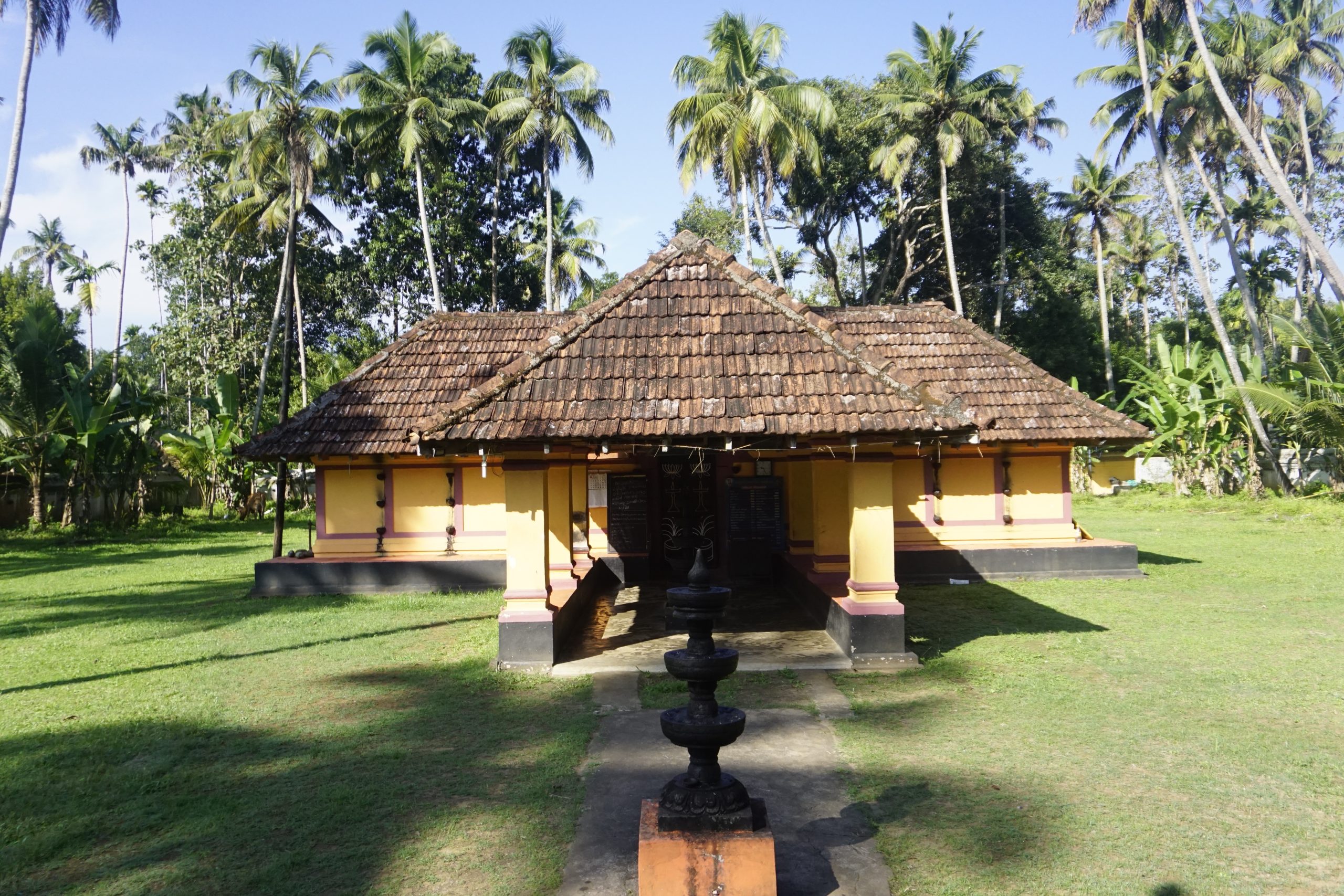
KALLELI SHASTHA TEMPLE
In Mupliyam village, on the eastern bank of the Kurumali River, lies the Kalleli Sasta Temple, also known as the Kalleli Sasta Kshetram. The origin of this temple’s name is tied to an intriguing story. The head of the Kalleli Brahmin household was a devoted follower of the Thiruvullakkavu Sasta. As he aged, the journey to the temple became increasingly difficult. One day, after visiting Thiruvullakkavu, he expressed his heartfelt struggle to the deity. Upon returning home, he placed his palm-leaf umbrella in the courtyard and retired for the night.
That night, he had a divine dream. In the dream, the deity reassured him, saying, “You do not need to travel to Thiruvullakkavu to worship me; I am right here in your courtyard.” The next morning, when he tried to pick up the umbrella to leave for Thiruvullakkavu, he found it firmly rooted to the ground. This very courtyard became the Sreekovil of the Kalleli Sasta Temple.
As time passed, the Kalleli household ceased to exist, and the land where Sasta resided, along with its properties, was entrusted to the Adiyalloor Mana. Thus, Adiyalloor Mana became the Uralar (hereditary trustee) of the temple.
Given the presence of the Thiruvullakkavu Sasta, the Kalleli Temple holds great significance for Vidyarambham (initiation into learning). The deity is considered a Swayambhu (self-manifested), and the surrounding area is covered with sand, making the traditional AshtabandhamKalasham impossible. Instead, a Dravya Kalasham is performed, with the Prathishta Day celebrated on Karthika in the month of Vrischikam.
To the east of the temple lies a Vishnu Temple (Kalleli Pidikkaparambu), closely connected with the Kalleli Sasta Kshetram. The Prathishta Day of the Vishnu Temple is celebrated on Atham with Tantri Puja, and on this day, special offerings and Navakam are performed at the Sasta Temple, highlighting the deep connection between the two temples.
The main festival at the Sasta Kshetram takes place during the Pooram season in the month of Meenam. The celebrations begin on Makiram day with the flag hoisting, marking the start of the eight-day-long festivities. On the night of Makiram, the ‘Vilakku’ (ceremonial lamp) is lit, and the Pani sounds as the flagpole is raised. The Marar blows the conch three times, and with the permission of the Uralars, the deity is taken out in a procession after completing seven circumambulations of the temple. The procession halts at a sacred stone near the banyan tree, where a coconut is ceremoniously cracked. The deity is then taken to the Vishnu temple for a circumambulation before returning to the Adiyalloor Mana for the Irakkipooja and the final procession back to the Sasta Temple.
On Thiruvathira day, the Tharakal Pooram is observed with processions at noon and night, accompanied by three elephants. The deity is ceremoniously brought to Adiyalloor Mana for the Irakkipooja. After that proceeds to the eastern side of the temple’s fields, where a well is inspected as part of the ritual. Circumambulate this well three times along with Medamkulangara Sastha. On Pooyam day, the morning begins with a visit to Kaipanjeri, followed by Irakkipooja and meals at Padathol, Narayanamangalam Manas in the evening before proceeding to the Peruvanam Pooram.
Upon arrival at Peruvanam Pooram, the Sasta joins the procession alongside the deities from Arattupuzha and Medamkulam. If the deity arrives early, they are placed near the banyan tree at Thodukulam. After the Chathakkudam Sasta’s melam concludes, the Sasta enters the temple and participates in the grand ‘Vilakku’ ceremony before departing just before the Cherpu’spooram at Peruvanam Nadavazhi. Upon returning, the deity is taken to Adiyalloor Mana for the Irakkipooja.
Legend has it that at Pidikapparambu Pooram, the Sasta was once insulted due to the location of his resting place at the foot of a hill. When the conch announced his arrival, someone mockingly called out, “Here comes the Thekkilakkadan, hold the Nakkila”. It is said that when the ritual offering was taken from the ceremonial vessel, the bottom of the vessel fell out. Since then, the Sasta has not participated in the Pidikapparambu Pooram.
On the day of Arattupuzha Pooram, after offering Para at Umampilly and performing puja and meals at Kaplingattu Mana, the Sasta continues to Cheruvathur, Ayiril, Vadakkedam, and Avanavatt Kaplingattu Manas for Irakkipooja before returning to Njeruvissery Kaplingattu mana. In the evening, the Sasta arrives at Arattupuzha Temple for the grand procession, where in earlier times, the deity would circumambulate the Tevar Mandapam. The next morning, at around 7:30 AM, the Sasta bids farewell and returns. In the evening, after performing the Irakkipooja at the Vishnu temple and Adiyalloor Mana, the festival concludes with nine circumambulations and the final flag-lowering ceremony, marking the end of the Pooram season.