


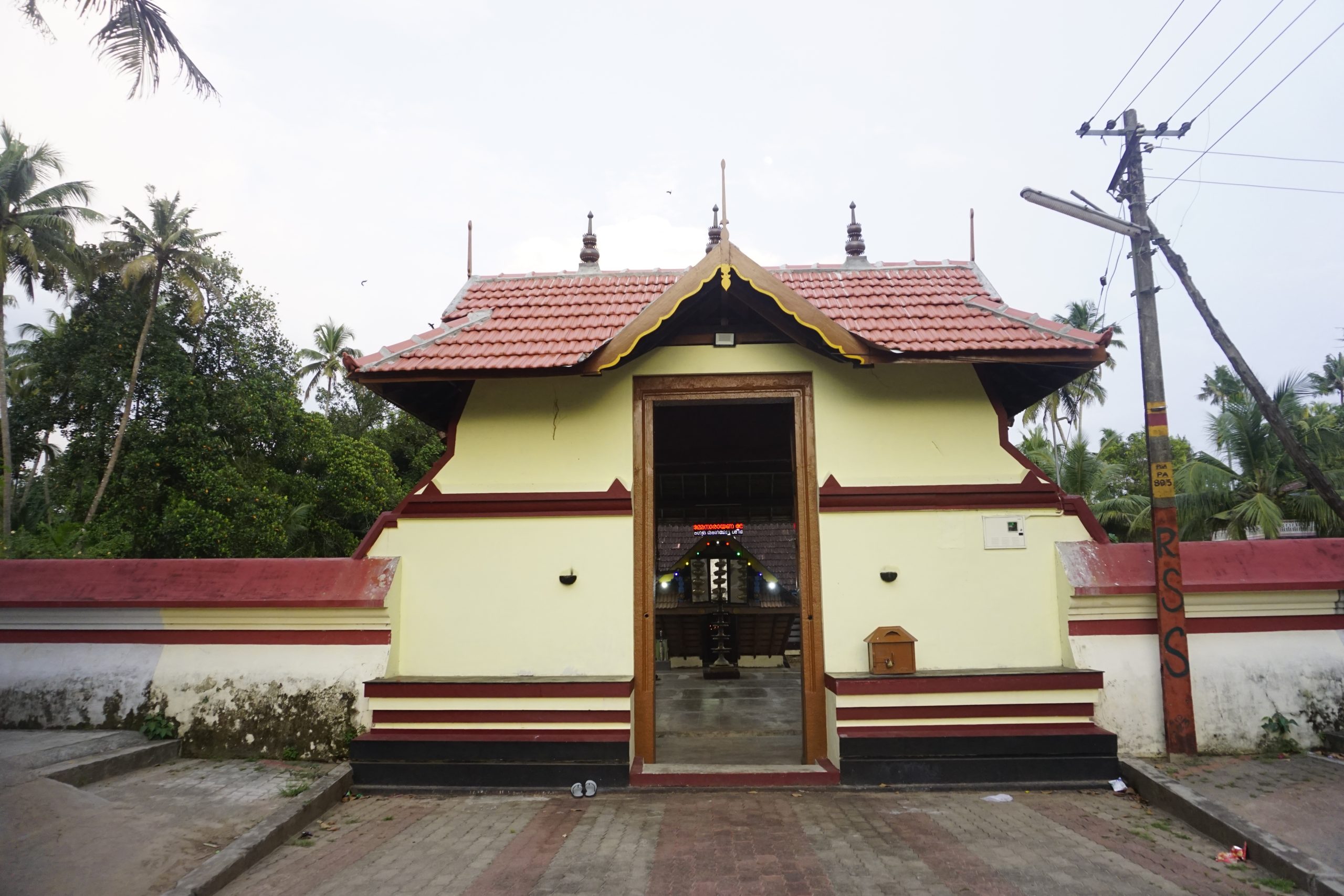
ANTHIKKAD SHREE KARTHYAYANI BHAGAVATHY TEMPLE
Among the 108 revered Durga temples, the Anthikad Sri Karthyayani Bhagavathy Temple stands as a prominent and celebrated shrine. This temple, located in the serene region of Anthikkad, is mentioned in a detailed article titled “Anthikad Bhagavathy Kshetram” by Sri P.K.M., published in the Kerala Kesari magazine, Vol. 2, Issue 12, Karkidakam month, of the year 1091 Kollam Era.
The temple is situated in a region historically known as Vaishyaashrama, Samadhivanam, and Sandhyavanam, as described in the Purushothama Stavam chapter at the end of the Devi Mahatmyam in the Markandeya Purana. According to the Devi Mahatmyam, this place is believed to be the sacred ashram where the great sage Samadhi Vaishya, who performed intense penance alongside King Suradha, resided.
On Sunday morning, the 7th day of Dhanu month in the year 1139 Kollam Era, the revered astrologer BrahmashreePuthussery Vishnu Namboothiri, through his astrological reading (Prasna Chart), revealed that the divine presence of the Goddess first manifested during a sacred Mandala period in the current Yuga, following the Krita and Treta Yugas of the 24th Chaturyuga in the Vaivasvata Manvantara. According to his calculations, it has been 173,094,944 years since this divine manifestation occurred.
The Prasna Chart reveals that after its initial divine manifestation, this sacred site became a continuous abode for sages and ascetics, embodying the undivided and complete form of the Goddess’s power. Over time, it flourished as a spiritual retreat but did not immediately evolve into a temple with established rituals. Numerous sages and yogis worshiped the deity in various forms, and for extended periods, the site remained hidden, its rituals neglected. Despite these interruptions, the inherent divine power of this sacred place remained ever-present, unaffected by the presence or absence of formal rituals. It existed as a radiant and sanctified Tapovanam, where the natural elements served as constant offerings, keeping the divine presence eternally satisfied.
Approximately 3,024 years into the Kali Yuga, or about 2,077 years ago, a Brahmin from Peruvanam village worshiped Goddess Mookambika with deep devotion. In response to his prayers, the Goddess, though invisible, manifested at this sacred site. It was from that time onwards, in the region known as Chempaka Vanam, that formal temple rituals and practices began
From May 1st to 11th, 1144 ME (Malayalam Era), the temple underwent a formal NavikaranaKalasham (renovation ritual). Additionally, a Dravya Kalasham (ceremonial offering) was conducted from August 1st to 10th, 1163 ME. In preparation for the NavikaranaKalasham, the temple’s former Uralars (hereditary trustees)—Karippilly Panikkar, NallottuChittarathu Kurup, and Ilayath of Pulinthra Illam—called a meeting and performed a purification ceremony before handing over the temple administration to a committee of devotees selected from the local community. Currently, the temple is managed in cooperation with the Cochin Devaswom Board and the Temple Service Committee.
The daily rituals, monthly observances, and annual festivals are detailed below..
Daily rituals:
At dawn, the temple doors open to start the day with Ganapathi Homam and Usha Pooja. Different houses bear the expenditures for Ganapathi Homam, Usha Pooja, and Nivedyam (offerings) in a daily cycle. Following these rites, the Ethirtha and Ucha Poojas are performed, and the temple doors are closed. In the evening, the temple reopens for Deeparadhana and Athazha Pooja before closing for the night. The timetable may change on special days or during Niramala observances.
Monthly Observances:
On the Karthika star day of each month, devotees sponsor a communal feast (Oottu) and a Niramala ceremony, where the temple is adorned with as many oil lamps as possible. Additionally, on the first Saturday of every month, a Niramala and a special Payasam offering are made for Lord Ayyappa at the Nirurukon shrine.
Annual Festivals:
- Navaratri and Vijayadashami are celebrated with great devotion, with each day sponsored by individual devotees. As the temple is dedicated to Mookambika, Saraswati Pooja holds special significance during this time.
- Thrikkarthika: The Thrikkarthika festival in the month of Vrischikam is celebrated as the birth anniversary of the Goddess. The festivities include processions with the deity mounted on an elephant, communal feasts (Oottu), and a grand Niramala ceremony.
- Pooram: The Pooram festival begins on the Makiram day of the Meenam month. The festivities commence with the traditional Ari Alavu ceremony in the evening, where the head of the committee grants permission for the ritual. At around 8:00 to 8:30 PM, the Arattu (holy bath) is performed in the temple pond, located 200 meters north of the temple, which still flourishes as a beautiful lotus pond. After the Arattu, the deity is taken back to the temple for the evening poojas, including the Sribhutabali. Following this, the grand Pooram Purappadu (procession) begins.
The procession exits through the western gopuram to the accompaniment of Chempada drumming, and the Panchavadyam ensemble continues until the western Pandal (it is a large open-sided temporary pavilion). After the traditional Keli and Pattu performances, the procession concludes with a grand Panchari Melam. Fireworks mark the end of the festivities, with the entire event wrapping up around 3:00 AM.
In the following days, the deity is taken to various neighboring regions like Vallur, PuthanPeedika, Karamukku, Manalur, Peringottukara, Chazhoor, and Alappat for Parayezhunallippu (procession with offerings). On the sixth day, after the procession, the deity returns to the temple. On the seventh day, the festival concludes with the morning Arattu before the deity is taken to Arattupuzha. At Arattupuzha procession is accompanied by the deity Churakkode Bhagavathy.
The following day, after the Arattu, the procession returns to Pazhuvil, where devotees have lunch and rest. In the afternoon, all remaining offerings are collected, and the festivities conclude with the UthramVilakku ritual at the temple.
It’s worth noting that only Thriprayar Thevar, OorakathammaThiruvadi, and Anthikad Bhagavathy (representing authority, wealth, and power) have the right to construct the mandapam for the Arattu at the Mandaram Kadavu in Arattupuzha, highlighting the significance of this sacred site.
- Kalasha Commemoration and Pratishtha Day: The Pratishtha Day (Consecration Day) is celebrated on the Makiram star of the Medam month with a grand procession (Ezhunnallippu) and related rituals. The day also features the Oottu and Niramala ceremonies, adding to the spiritual fervor.
- Vavarat: The Vavarat ceremony takes place in the temple pond during the Thulam month, marking another significant observance in the temple’s annual calendar.
- Vishu Pooram: Vishu is celebrated with a smaller-scale
Pooram, adding a festive touch to this auspicious day.
These events are carried out with deep devotion and the sincere collaboration of the Karma Samiti and the Cochin Devaswom Board, ensuring that the temple’s traditions continue to be honored and upheld.
Temple Deities and Installations:
The primary deity of the temple is Goddess Mookambika. The consecration of the idol is steeped in tradition and reverence. For the NavikaranaKalasham (renovation ritual), a devotee was sent to Mookambika, where they performed a week-long Bhajanam on the banks of the Souparnika River. The idol was crafted from a sacred stone found during this period, retrieved from the riverbed with the help of the local priest. This stone was then placed on a base (Peedom) designed with great care, with the previous idol resting below in a specially constructed chamber that resembles a cave. Gold wires were inserted to connect the old and new idols, symbolizing continuity.
The temple also has a separate festival idol (Utsava Thidambu), adorned with a gold orb, a Tilakam, and other ornaments during festivals. Additionally, in the Vayu (northwest) corner, the temple houses a Brahmarakshas and in the Nirutthi (southwest) corner, there is an idol of Sri Bhoothanatha, each enshrined in special sanctums. The temple also has a shrine for Shoolini Bhagavathy, where special offerings of Niramala and Payasam are made on every 30th Saturday for devotees who are preparing for their pilgrimage to Sabarimala.
Idols of Ganapathi and Shiva are installed in the southwest corner of the temple’s Chuttambalam (outer structure).
Priests, Tantri, and Temple Custodians
The temple’s Tantri (chief priest) lineage belongs to the Pazhangapparambu Mana. Initially, the responsibilities were handled by the Tharunanalloor family, later delegated to KolangaduChoruḷi Namboothiri. However, after the second one had given up the post, thePazhangapparambu family was officially installed as the Tantri.
The Melshanti (head priest) hails from the Tulu Brahmin community, specifically the Navaratta Illam of Mangalore. This privilege was granted to them because they brought the deity Mookambika from Kollur. Despite disputes regarding the transfer of the Melshanti position, the Cochin Devaswom Board upheld their traditional rights through a High Court order on 18/11/1987 (R. Dir 3/96/86), ensuring their role remained intact without enforcing any transfers.
The Kazhaka (temple administration) is managed by the Anthikad Warrier family.
Subsidiary Temples
Adjacent to the main temple, on the northern side near the temple pond, lies the VadakkekkaraSreekrishna Temple, and further east, the Puthampillli Bhadrakali Temple. These are considered the subsidiary temples. The Ashtami Rohini festival is celebrated with grandeur at the Sreekrishna Temple, while the Makarabharani festival is the highlight at the Bhadrakali Temple.