

History of Panchavadyam
Panchavadyam (Malayalam: പഞ്ചവാദ്യം), literally meaning an orchestra of five instruments, is basically a temple art form that has evolved in Kerala. Of the five instruments, four — timila, maddalam, ilathalam and idakka — belong to the percussion category, while the fifth, kombu, is a wind instrument.
Much like any chenda melam, panchavadyam is characterised by a pyramid-like rhythmic structure with a constantly increasing tempo coupled with a proportional decrease in the number of beats in cycles. However, in contrast to a chenda melam, panchavadyam uses different instruments (though ilathalam and kompu are common to both), is not related very closely to any temple ritual and, most importantly, permits much personal improvisation while filling up the rhythmic beats on the timila, maddalam and idakka.
Panchavadyam bases itself on the seven-beat thripuda thaalam (taal) but amusingly sticks to the pattern of the eight-beat chempada thaalam — at least until its last parts. Its pendulum beats in the first stage (pathikaalam) total 896, and halves itself with each stage, making it 448 in the second, 224 in the third, 112 in the fourth and 56 in the fifth. After this, panchavadyam has a relatively loose second half with as many stages, the pendulum beats of which would now scale down to 28, 14, 7, 3.5(three-and-a-half) and 1.
It is difficult to estimate the time when Panchavadyam originated. Formally this was part of royal processions but in course of time it became an indispensible factor in temple rituals and festivals. Its elaborate form in vogue today came into existence in the 1930s. It was primarily the brainchild of late maddalam artistes Venkichan Swami (Thiruvillwamala Venkateswara Iyer) and his disciple Madhava Warrier in association with late timila masters Annamanada Achutha Marar and Chengamanad Sekhara Kurup. Subsequently it was promoted the late idakka master Pattirath Sankara Marar. They dug space for a stronger foundation (the Pathikaalam), thus making pachavadyam a five-stage (kaalam) concert with an intelligent mixture of composed and improvised parts. Spanning about two hours, it has several phrases where each set of the instruments complement the others more like harmony in the Western orchestra than the concept of melody in India. Much like in Panchari and other kinds of chenda melam, panchavadyam, too, has its artistes lined up in two halves, facing each other. However, unlike any classical chenda melam, panchavadyam seemingly gains pace in the early stages itself, thereby tending to sound more casual and breezy right from its start, beginning after three lengthy, stylised blows on the conch (shankhu).
A panchavadyam is anchored and led by the timila artist at the centre of his band of instrumentalists, behind whom line up the ilathalam players. Opposite them stand the maddalam players in a row, and behind them are the kompu players. Idakka players, usually two, stand on both sides of the aisle separating the timila and maddalam line-up. A major panchavadyam will have 60 artistes.
Panchavadyam is still largely a temple art, but it has come out of its precincts to be seen performed during non-religious occasions like cultural pageantry and according welcome to VIPs.
Although Peruvanam – Arattupuzha Pooram is dominated by chenda melam (Panchari, Pandi etc), panchavadyam is also performed in a number of occasions such as Makeeram day at Anthikkadu Bhagavathy temple, Punartham day at Thaikkattussery Bhagavathy temple and Chakkamkulangara Sastha temple, Pooyam (Peruvanam Pooram) day at Thayamkulangara (Cherpu Bhagavathy), Aayilyam day at Thriprayar (Thriprayar Thevar), Pooram day at Thottippal Bhagavathy temple, Pooram day at Arattupuzha (Thriprayar Thevar), Uthram day at Kodakara (Poonilarkkavu Bhagavathy), Edakunni Bhagavathy temple and Thriprayar Sreerama swami temple and Atham day at Nettissery Sastha temple.
Instruments
Thimila (Malayalam:തിമില) is an hour-glass shaped percussion instrument used in Kerala, South India, that produces a powerful and resonant sound. It is a major percussion instrument used in sree-bali, sree-bhootha-bali and related temple rituals. It is one of the constituting instruments in Panchavadyam. It is made of polished jackwood, and the drumheads made of calfskin (preferably taken from 1- to 2-year-old calf) are held together by leather braces which are also twined round the waist of the drum. (Nowadays even fiber heads are used instead of animal skin. The two heads are “Moodu vattam” or “Bass head” and the “kottu vattam” or “Treble head.”). This mechanism helps in adjusting the tension and controlling the sound, mainly two: ‘tha’ and ‘thom’. There is a small hole called ‘Karnna dwaram’ on the body of Thimila situated at the middle part of hour-glass shaped body. Played with fingers, the thimila offers a wide range of rhythmic possibilities. It is a vital component in temple rituals, and folk performances. With its vibrant sound and cultural significance, the thimila has gained global recognition and is now embraced in various contemporary and fusion music genres. The thimila continues to captivate audiences with its rich cultural heritage, rhythmic complexity, and captivating resonance, making it an enduring symbol of South Indian percussion traditions.
The Madhalam or Shuddha madhalam (Malayalam: മദ്ദളം) is a drum made out of the wood of the jackfruit tree. It has two sides or heads for playing, made out of leather, and has different kind of sounds on each side. Two heads are tightened together on body by leather straps. The madalam is a heavy instrument which is hung around the waist of the person playing, and the player stands all the while to perform. The maddalam is a vital instrument in traditional Kerala percussion ensembles like Panchavadyam, Keli, Krishnanattam and Kathakali orchestra. The maddalam is an instrument that holds a special place in many musical performances. The maddalam, a large form of the mridangam, has musicality. The maddalam has an idanthala and a valanthala. On the valathala side, central portion of the side is applied with a paste of mixture of charcoal and rice, in a small circle. The aim of this is to correct the sound or pitch of the madhalam. In ancient times Madhalam was played by suspending it from the neck of the player and it was called ‘Thoppi madhalam’.Thoppi madhalam has no difference between two heads. That means Idamthala and Valathala produce same sound. Later in the 1920s Madhalam maestro Venkichan Swamy changed the style to the way it was suspended from the waist of the player
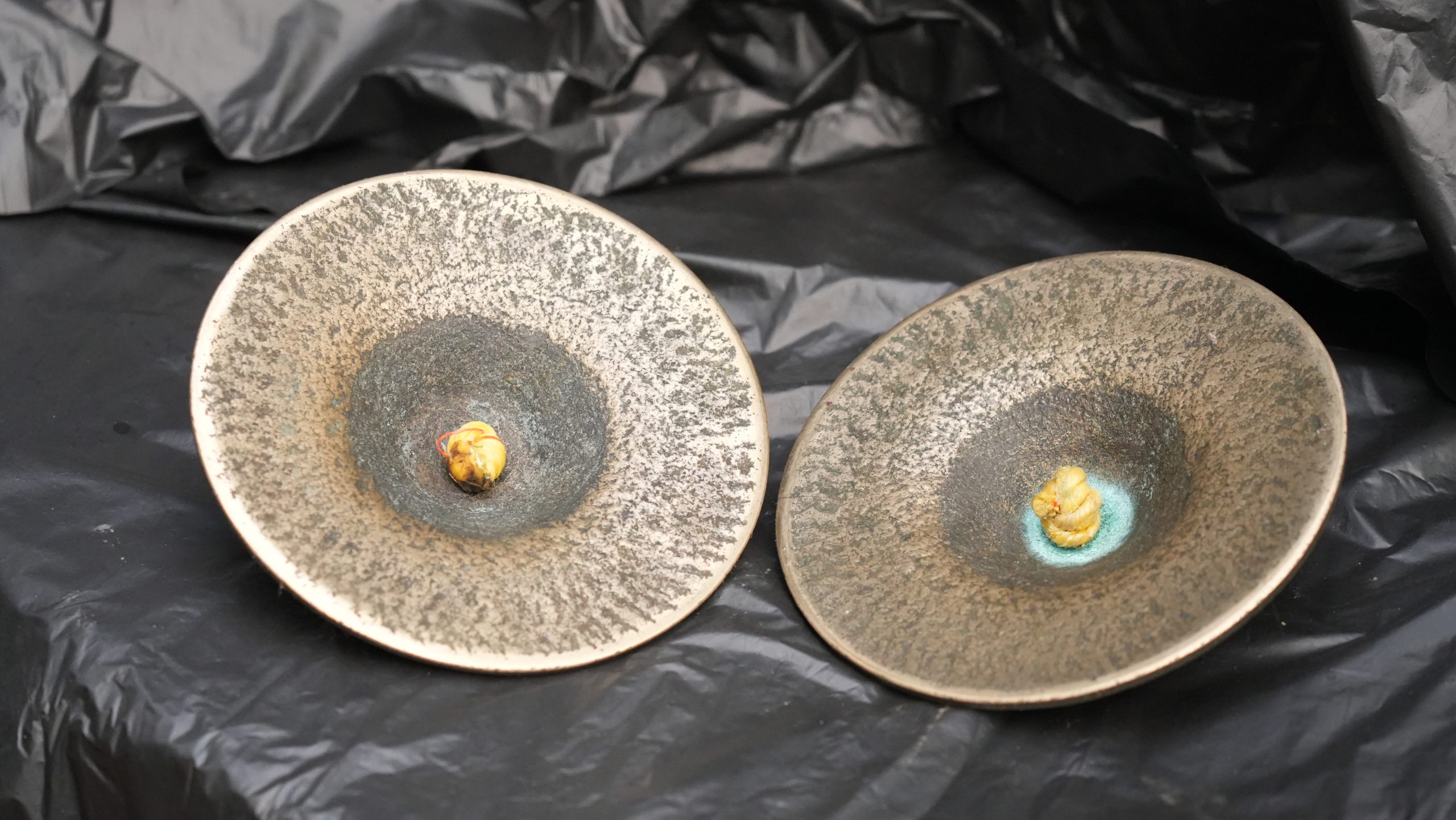
Elathalam, or Ilathalam, is a metallic musical instrument (Ghana vadyam -ഘനവാദ്യം in Malayalam) which resembles a miniature pair of cymbals. This instrument from Kerala in southern India is completely made out of bronze and has two pieces in it. A string is passed through a hole in the middle of the leaf cymbal and rings are attached to the string. Ilathalam is played by keeping one part of the cymbal in left hand banging the other cymbal to the one in left hand. Even though this instrument is small by size, it does have more thickness than the common cymbal, and thus gives a distinct chime. Ilathalam is never a lead instrument but is used in a number of ethnic Kerala percussion ensembles like Panchavadyam, Chenda melam and Thayambaka. It is also used by the second singer in a Kathakali performance, and to provide the beat in Kuzhal Pattu and Kombu Pattu. The name ilathalam comes from its resemblance to a lotus flower, or tamara in Malayalam.
The Kombu ( Malayalam: കൊമ്പ്) is a wind instrument (horn) usually played along with Panchavadyam, Pandi Melam, Panchari melam etc. This musical instrument is usually seen in south India. The instrument is like a long horn (Kombu in Malayalam). In recent research found that the kombu resembles trumpets being used in ancient Ireland and felt this was evidence of a link between peoples in South India and those in Ireland, 2000 years ago. In ancient days kombu played during war along with certain type of drum. Modern kombu made out of bronze either in ‘C’ shape or ‘S’ shape. In Kerala ‘C’ shaped Kombu is used and it plays an important role in the Panchavadyam and all types of Melams like Pandi, Panchari, Chembada etc. However, as prelude to melams, it is also used to present solo concert (with Ilathalam, a miniature pair of cymbals, as accompanying instrument), in which case it is called Kombu Pattu. The Kombu is a wind instrument. It is a curved tubular instrument made of bronze. It has three parts: a lower part that is the size of a little finger and is held in the mouth, a middle part that gradually increases in diameter, and an upper part that increases in diameter and is open. These three parts are separated and reassembled when it is time to blow. It requires breath control and good practice to blow it..
The idakka is a percussion instrument from Kerala, India. It is also known as edakka or edaykka. The idakka is categorized among the Mangala Vadyas (auspicious instruments). The idakka consists of two circular drum heads each of which is mounted within a circular ring. The hourglass-shaped body is placed between the two heads and lacing is used to pull the two rings towards each other, stretching each drum head over an open end of the body. Two strings made of natural fiber (skeins or horsetail) are stretched across the open ends of the drum body, under each drum head. The Idakka is a small, high pitched drum with definite pitch. The snares running under the drum heads have been found to interact with the vibrating membrane in a way that causes the pitch of the instrument to be determinate. Different pitches can be obtained by squeezing the lacing around the instrument, which changes the amount of tension in the skins. Two rows are tied to the body on either side. The rings are much larger than the body. The liver skin of a cow called Othali is used for the rings of the Idakka. It is tightened with a string. Four round pieces of wood with sixty-four tassels are used to control the sound. The string placed in the middle of the body is tied together and the sound is controlled by using a small curved stick. It is not uncommon for the diameter of the drum heads to be larger than the diameter of the body, with the result that the drum heads are often seen mounted significantly off-center. The idakka is played with a curved wooden stick from the right side of the instrument. The idakka is a traditional instrument from Kerala and is known as Deva Vadyam. The idakka is used in temple rituals, dance performances, Sopanam music (Astapadi, Kottipadi seva) and as part of the panchvadhyam ensemble. The idakka is also used to accompany classical dances like Kathakali and Mohiniattam.
Photos