

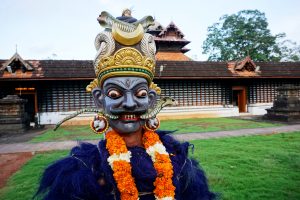
Kummatti or Kummattikali is a famous colourful mask-dance of Kerala prevalent in Thrissur, Palakkad districts and parts of South Malabar, active in the festive time of Onam. It is a folk dance where the dancers wear painted woody masks and clad in outfits made of grass and leaves with themes taken from the Hindu epic Ramayana, story of Siva etc. Kummatti is ritualistic devotional folk art of Kerala. Kummatti is an important part of Onam celebration at Peruvanam and adjacent villages Cherpu and Urakam. Kummatti is performed at Peruvanam on 2nd Onam day (Avittam day of malayalam month Chingam). Kummattikali starts from the West nada (entrance) of Peruvanam Mahadeva Temple. Accompanied by different types of drums and music, the procession goes around Peruvanam temple and finally reaches the East nada (entrance) where the event ends. On the 3rd Onam day (Chathayam day) Kummatti-kali is conducted at Cherpu. From the different parts of village, teams participate in the celebration and at the end, they all assemble near the Cherpu Bhagavathy temple. On the 4th Onam day (Pooruruttathi day) famous Urakam Kummatti is celebrated. Many teams participate in the event. All the teams circumambulate the Urakam Ammathiruvadi temple and move to Maimbilly temple, the end point of Kummatti.


Thaipooyam (in Malayalam) or Thaipoosam (in Tamil) is a Tamil Hindu festival celebrated on the first full moon day of the Tamil month of Thai (malayalam month Makaram) coinciding with Pusam (Pooyam star in malayalam) star. The festival is celebrated to commemorate the victory of Hindu god Murugan over the demon Surapadman. During the battle, Murugan is believed to have wielded a vel, a divine spear granted by his mother, Parvati. Thaipooyam is celebrated in all Subramanya (Murugan) temples in Kerala and Tamilnadu. The festival includes ritualistic practices of Kavadi Aattam, a ceremonial act of sacrifice carrying a physical burden as a means of balancing a spiritual debt. Worshipers often carry a pot of cow milk as an offering and also do mortification of the flesh by piercing the skin, tongue or cheeks with Vel skewers. According to the Kanda Puranam (the Tamil version of the Skanda Purana), three asuras (a race of celestial beings) Surapadman, Tarakasuran, and Singamukhan performed austerities to propitiate the Hindu god Shiva. Shiva granted them various boons which gave them near-immortality and the ability to conquer the three worlds. They subsequently started a reign of tyranny in their respective realms and oppressed the celestial beings including the devas and other people. The devas pleaded Shiva for his assistance to put an end to the reign of Surapadman and the asuras. In response, Shiva manifested five additional heads and a divine spark emerged from each of the six heads. Initially, the wind-god Vayu carried the sparks, but the fire-god Agni took possession of them afterwards because of the unbearable heat. Agni deposited the sparks in the Ganga river. The water in the Ganga started evaporating due to intense heat, and so the goddess Ganga took them to the Saravana lake, where each of the sparks developed into a baby boy. The six boys were raised by handmaidens known as the Kṛttikās and they were later fused into one by Parvati, thus giving rise to the six-headed Murugan. Parvati granted him a divine spear known as the Vel. Murugan was accompanied by Virabahu who served as his commander-in-chief and eight others, who were sons bore by nine shaktis who arose from the gems of the broken anklet of Parvati, when she ran from her seat due to the heat generated by the sparks emanating from Shiva. Along with the armies of the devas, Murugan waged war on the asuras. Murugan split Surapadman into two with his vel and the two halves transformed into a mango tree and later into a peacock and a rooster. Murugan adopted the peacock as his mount and took the rooster as his flag. Thaipooyam festival is celebrated to commemorate the victory of Murugan over the Surapadman. In Peruvanam gramam Thaipooyam is celebrated at Subramanya temple, Thayamkulangara, which is situated north-west of Peruvanam Mahadeva temple. Kavadi Attam is most important part of Thaipooyam. The most spectacular practice is the carrying of Ambalakavadi, one shaped like the gopuram (tower) of a temple decorated with peacock feathers and Pookavadi (A Pookavadi is one decorated with brightly coloured artificial flowers). The dancers twist and spin in a row. A group of such kavadi dancers make an exotic sight. The dancers gradually move in a frenzy, in step with the rising beats of percussion instruments like Chenda or wind instrument like Nadaswaram. Many teams in and around Thayamkulangara participate in Thaipooyam festival. Out of them, two teams – Thayamkulangara Kavadi samajam and Cherpu kacadi samajam- will have Chariots decorated with garlands and colourfull illumination.The idol of God Subramanya (Murugan) would be placed inside the chariot. Celebrations starts in the morning, the procession of Kavadi and Chariot accompanied by different orchestra starts from nearby Hidumban temple and ends in Subramanya temple. Repetition of procession takes place during night. In the evening and next day early morning there is Ezhunnellippu (elephant carrying idol of Subramanaya) with percussion.


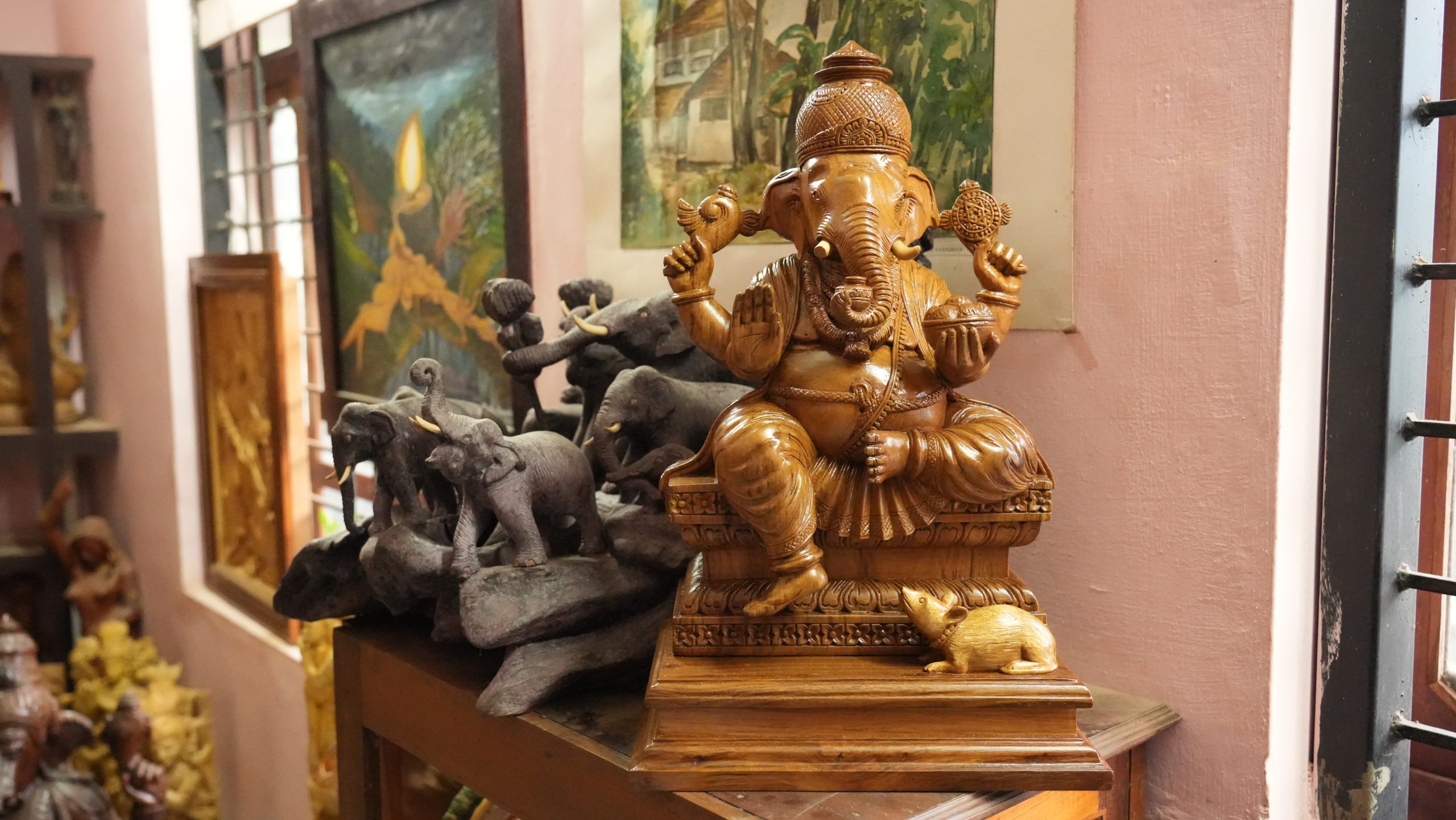
Cherpu, a village near the present Peruvanam, is one of the most important centers in Kerala for making handicrafts and wooden items. The place where these artists live is known as Asharikunnu (Ashari means carpenter). The senior most sculptor among those alive today, K. R. Vijayan, says that this woodworking has a tradition of about 400 years. In the past, various sculptures installed in temples and palaces were made here. Artists from here have done works in many sanctuaries including Cherp Bhagavathy Temple, Peruvanam Mahadeva Temple, Thayamkulangara Temple, Tripunithura Hill Palace and others.
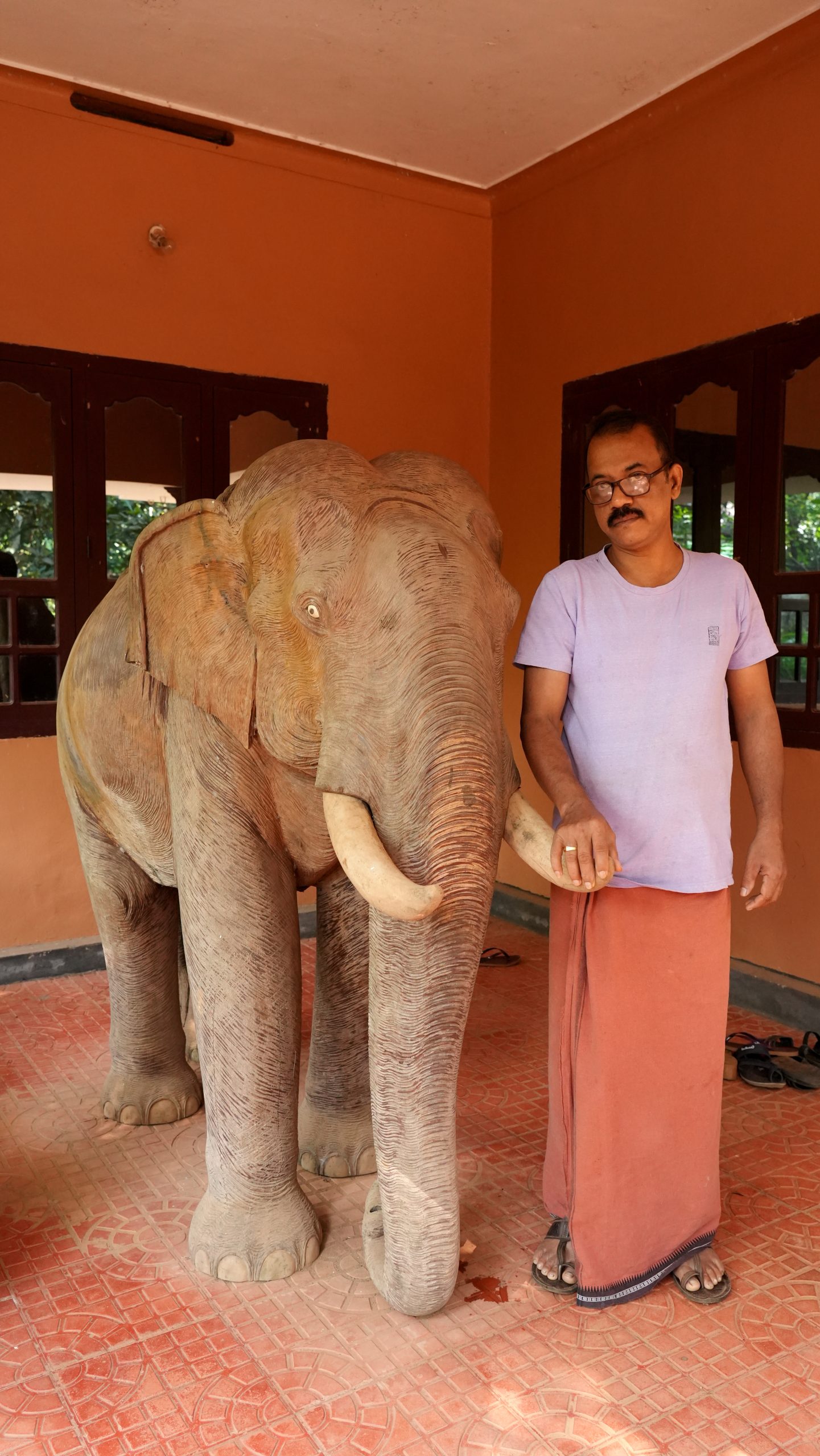
But it was when the carving of elephants started that the world began to know the importance of this village. Elephants are an integral part of the lives of people in Kerala, especially in Thrissur. The current form of the Peruvanam – Arattupuzha Pooram itself is about 1442 years old. When we hear the word Pooram, elephants and ensemble come to mind. At one time, 101 elephants were used for a procession in Arattupuzha. Such closeness and love for elephants may have inspired the creation of wooden elephants. Many people started buying elephant sculptures, that too in various sizes and shapes, and using them as decorations in their homes.
Since ancient times, there have been five families involved in carpentry here. They were Kizhakkoot, Vadakkoot, Thekkiniyedath, Padinjaroot and Madathumpadi. The Kizhakkoot family focused on carving, the Thekkiniyedath family focused on carpentry, and the Madathumpadi, Vadakkoot and Padinjarott families focused on architectural carpentry. The last two families are no longer active. The Knowledge and skills for the art was passed solely through families. Wood craftsman KR Vijayan says that about 75 years ago, a Chettiar from Virudhnagar, Tamil Nadu, came to Cherpu in search of sculptors who could make elephants. The golden age of elephant carving began when this Chettiar started ordering elephants and other sculptures in bulk for VTI (Victoria Technical Institute). Gradually, the demand for other sculptures also increased. In 1972, Republican candidate Richard Nixon, who ran for president in the United States, had ordered about 5,000 wooden elephants from Cherpu and taken them to America for his election campaign, as it is the symbol of Republican party. There is also a history of the Pope once being honored with a sculpture of a caparisoned elephant standing at the gate of church at Vathican city. The chariots of Cherpu and Thayamkulangara Kavadi samajams and idols of Lord Subramanya in them were made by the wood craftsmen from Cherpu. The idol on the chariot of Cherpu Kavadi Samajam is made by craftsman Ayyakutti of Madathumpadi family. Even though family background was architectural carpentry, Sri Ayyakutti learnt sculpturing. He was a great sculptor and his works are there in many places including Thrissur museum. Now the tradition is followed by Sri M.R. Raju who is a sculptor at the same time expert in clay modeling, painting etc. Ramachandran Cherpu, Aravindhan, Murali, Vinod, Babu and Manikandan are some of the wood craftsmen from Cherpu.
The artisans of Cherpu have organised to form The Cherpu Carpenter’s Co-Operative Society that works as a production centre and sales outlet of Cherpu elephant sculptures. The price of the sculptures depends on their size. A person from Peruvanam, Sri Krishnankutty Menon, Appozhath House, his name has to be mentioned with gratitude as he promoted the sales of wood carvings from Cherpu , in India and abroad thus helped these artists to earn a decent price for their creations.
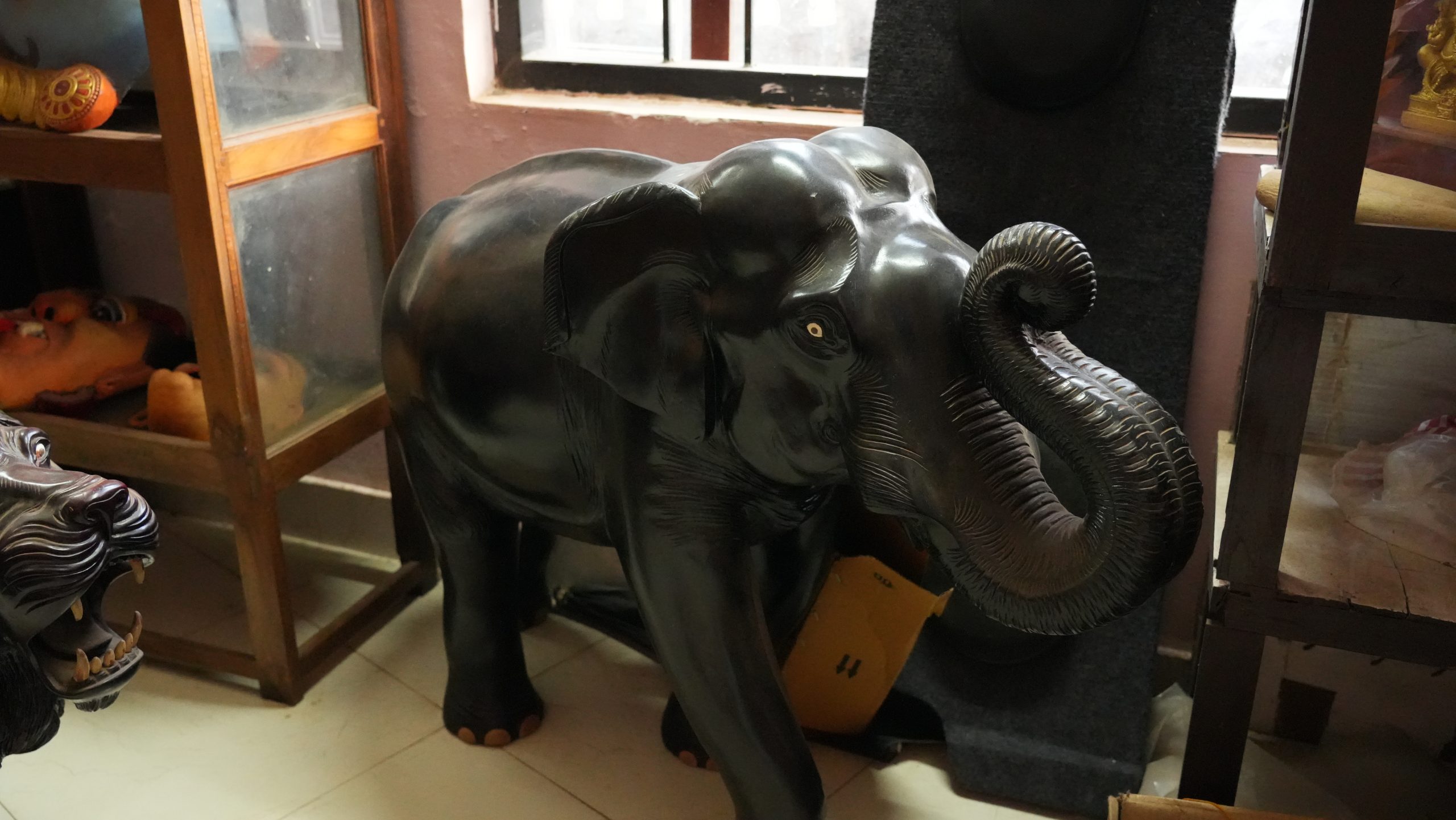
Apart from other wooden crafted elephants, Cherpu elephants have its own identity and unique features. And the major uniqueness of this art is the skilled making of the artisans, the realistic proportions, the choice of woods, and the details that impart the genuine look of the animal itself. The lines on its skin, unique to each according to the different means of strokes, the wrinkles on his trunk and body, the sharpness of its eyes, the perfect fit of nails, and the folds on his forehead that make this wooden creation exceptionally magnificent with its realistic look and intricate design. (Ref: AANAMAKER – THE ELEPHANT MAKER Cherpu, Thrissur – wordpress.com)
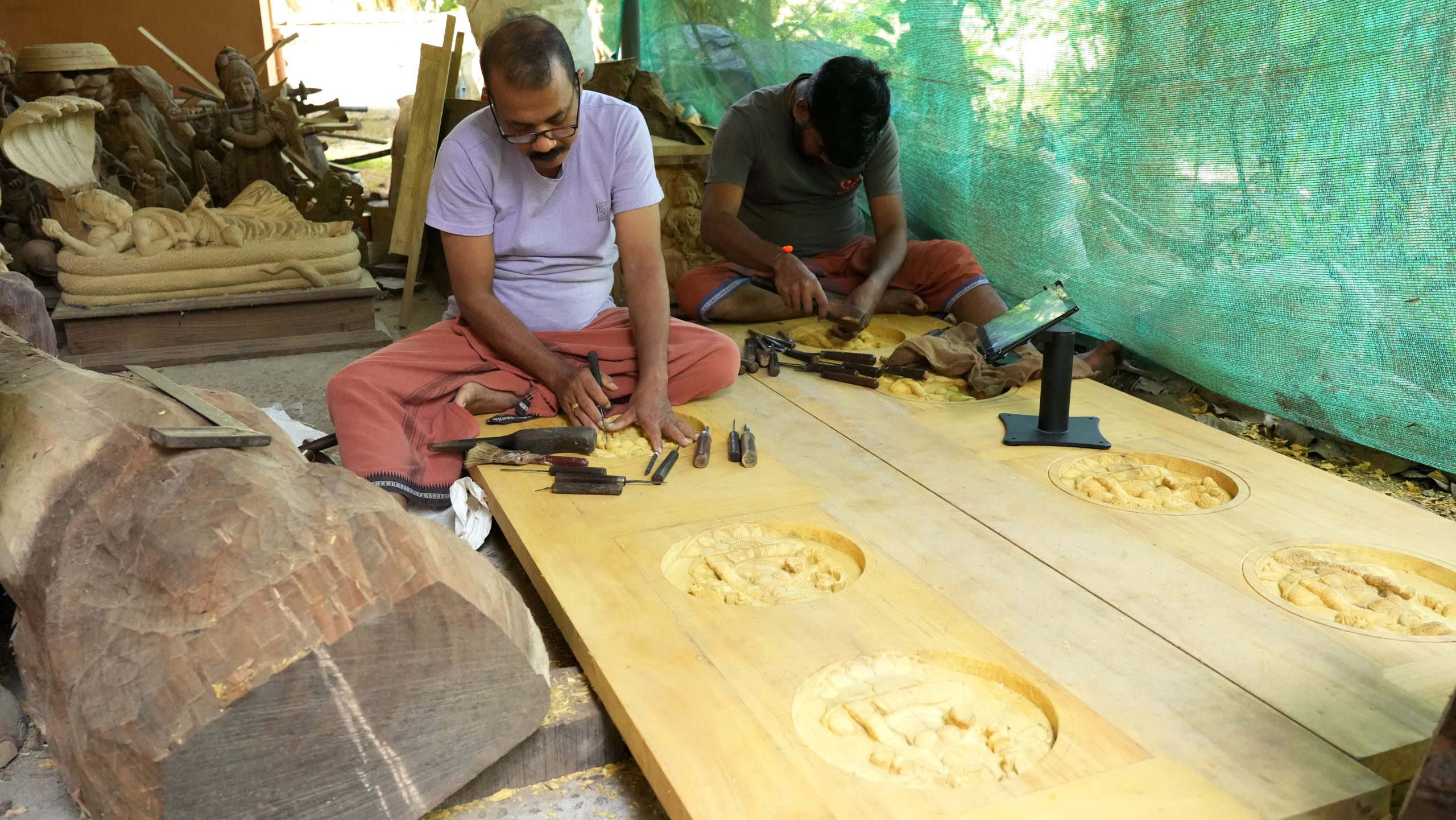
Elephants ranging from three inches to five or six feet tall are made in Cherpu. The woods commonly used for elephant making are Veetti or Eetti (Rose wood), teak, mahogany, and Vaka (Rain tree, local name Madirashi). White color fillers of White Teak or ‘Kumizhu‘, and White Cedar or ‘Vellakil‘, are used for the nail, eyes and tusks. The Cherpu wooden elephant carvings are simple conventional ones, using only indigenous technologies, no industrial method or machinery is included for the work; it is a complete hands-on experience. Therefore, these sculptures are excellent examples of the sculptor’s imagination, talent, and craftsmanship.
Selected wood as per consumer, hammer, chisels of different types and shapes, Sanders, Jigsaw, Pencil / Chalk / Crayon, corrugated Cardboard Stencil of Elephants , Timber coat wood finishes, shoe polish, Wood primer, sanding sealer, Thinner and wood stainer paint, dry emery paper, Pad saw and Wood stain are the tools and materials used to craft Wooden elephants and polish them.
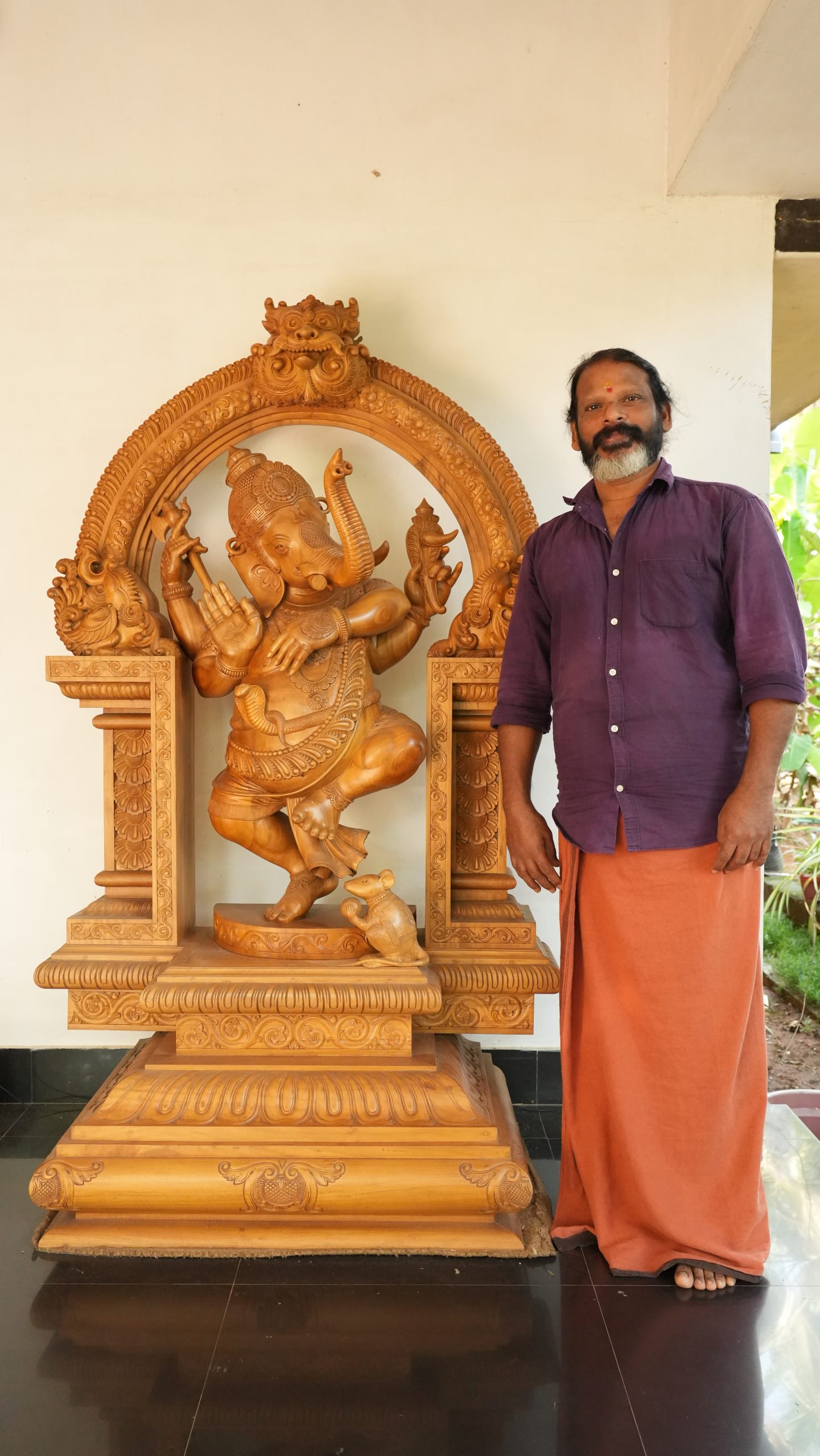
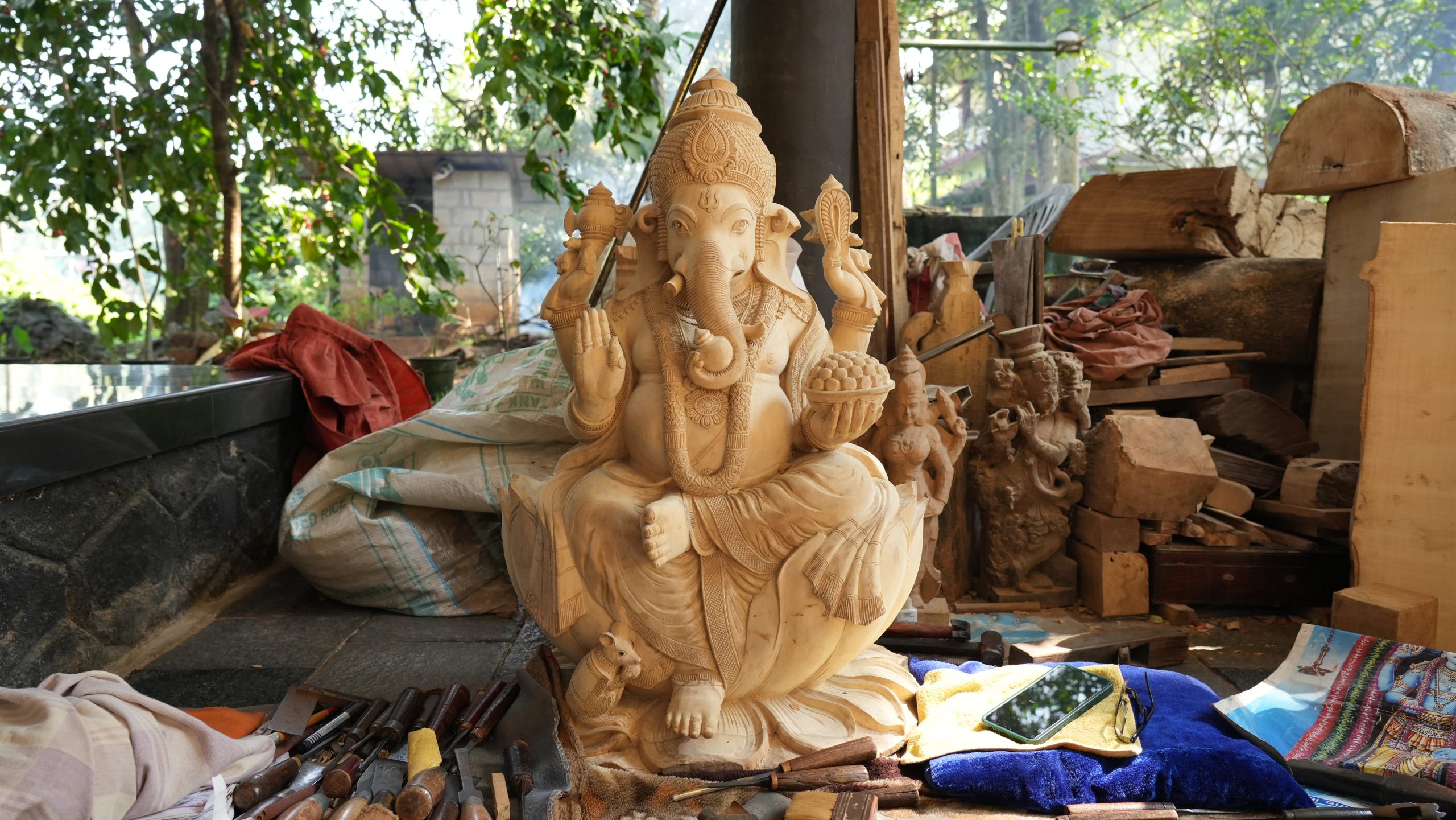
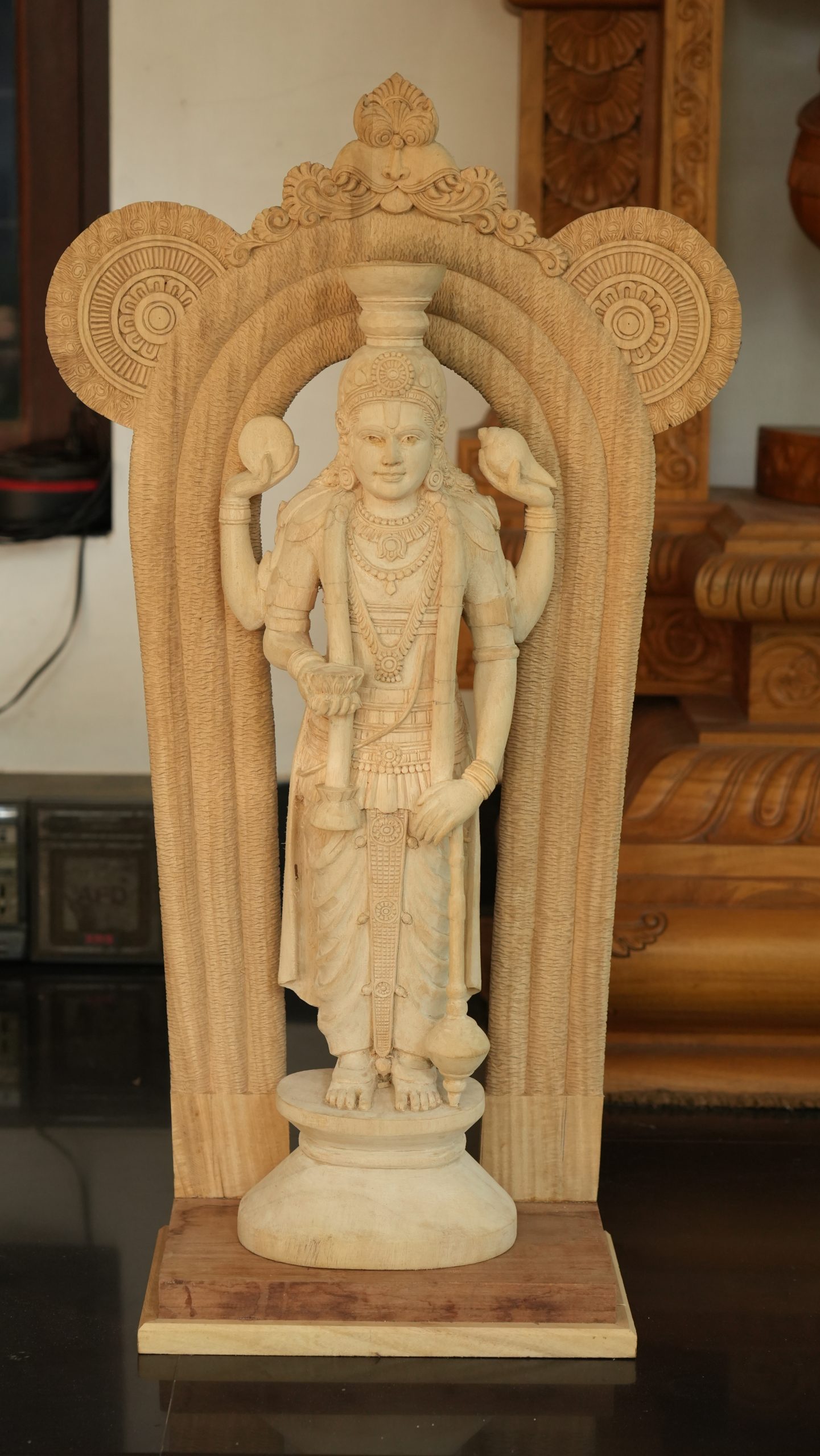
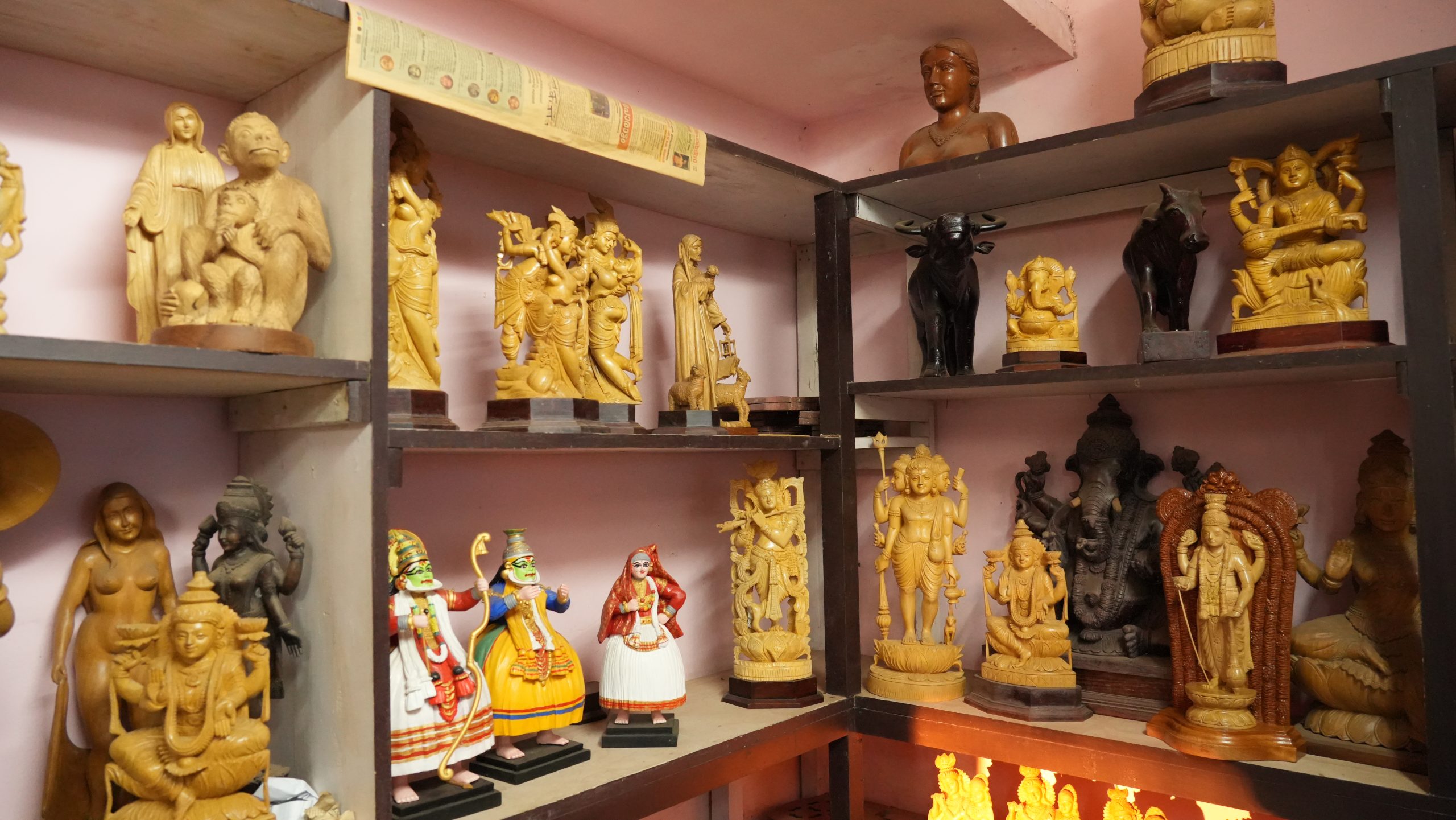
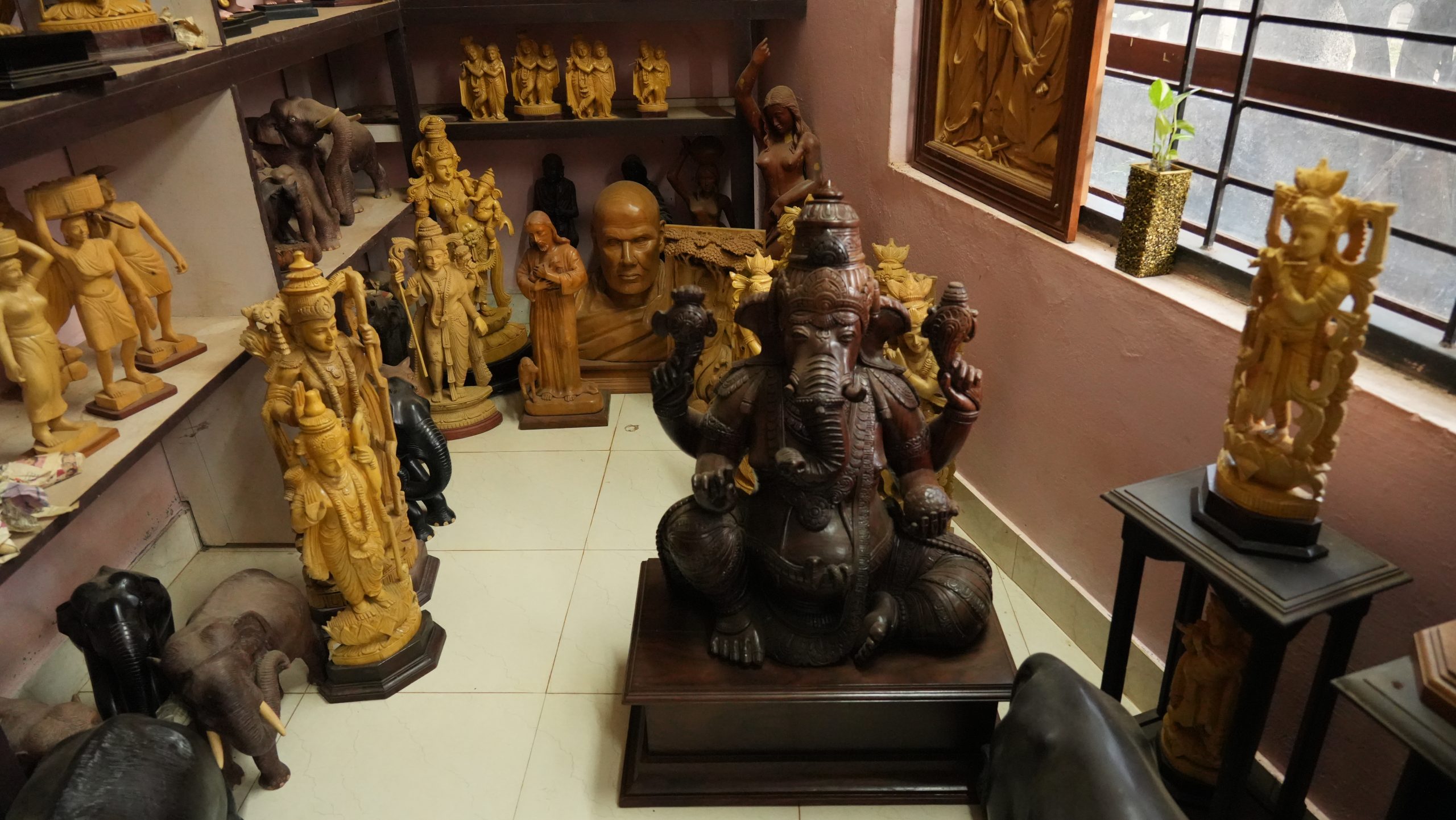
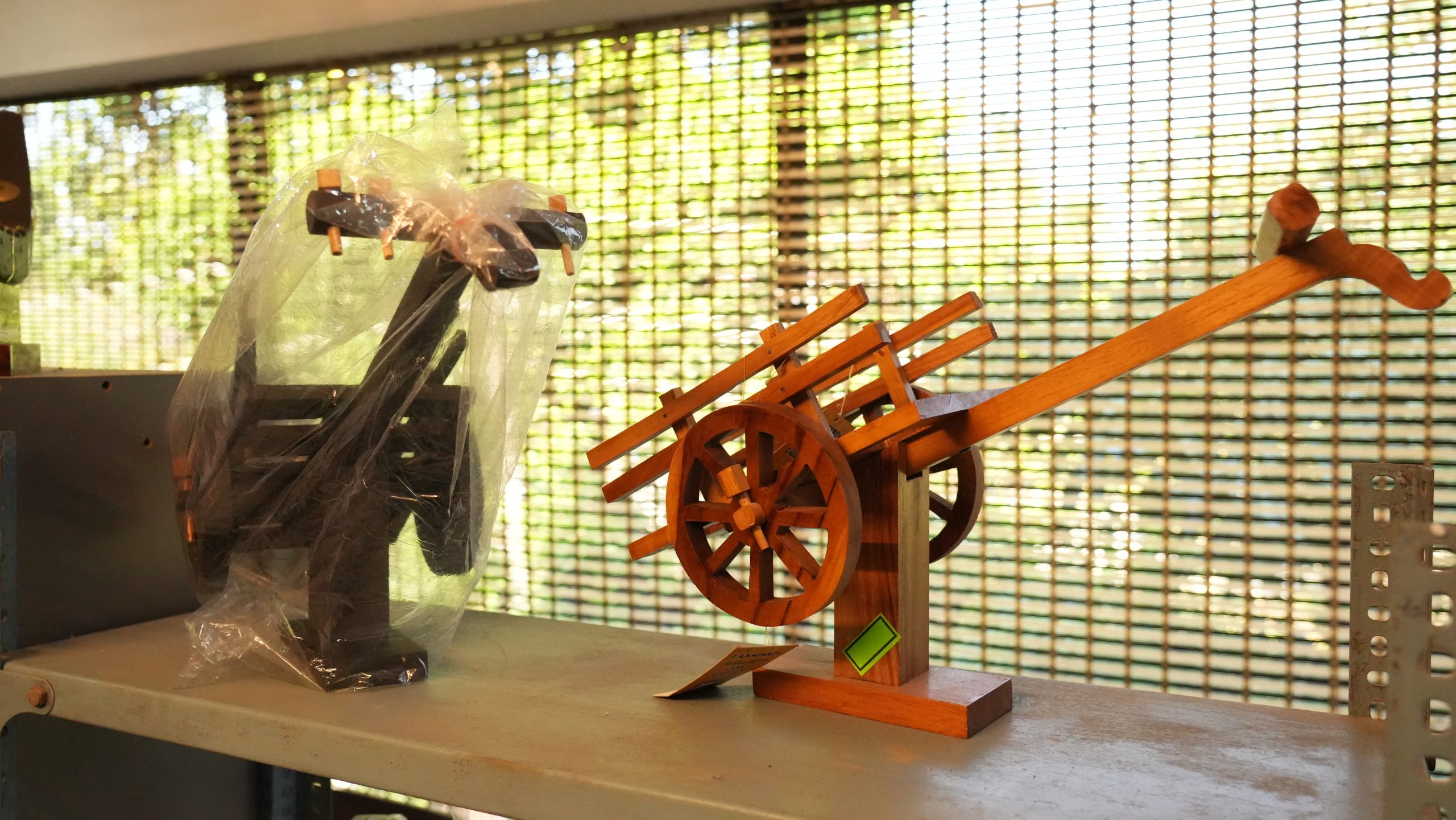
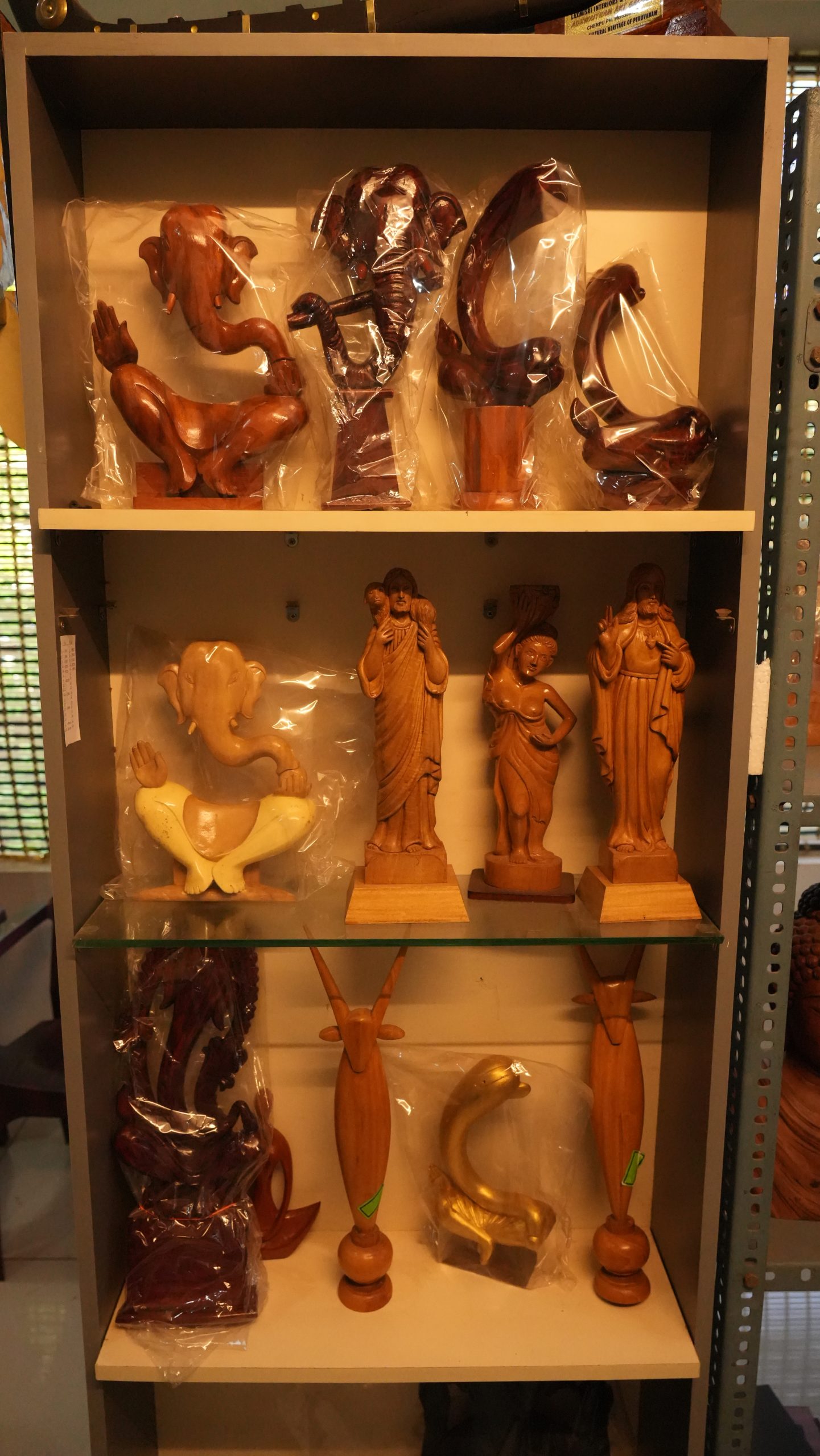
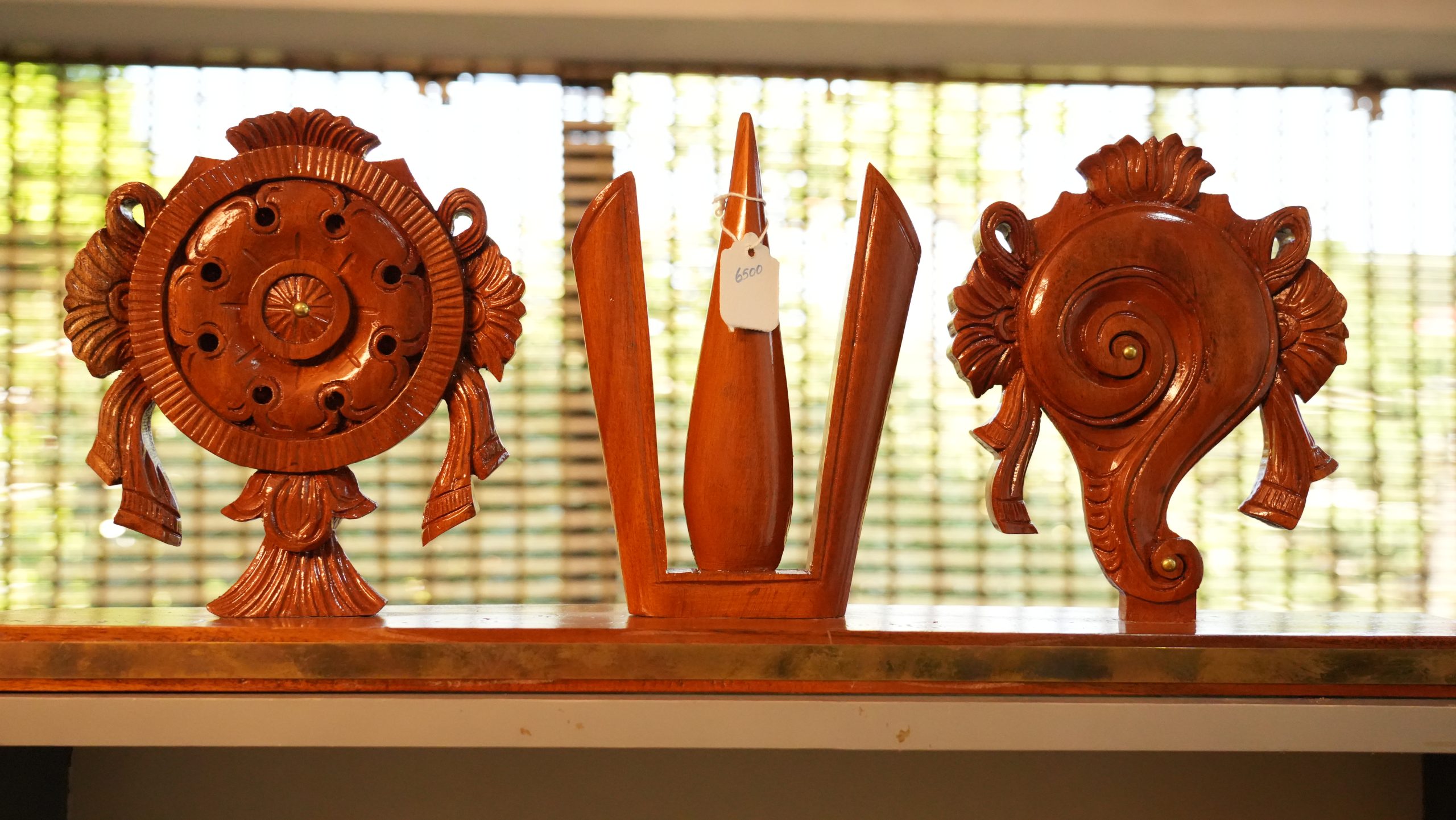
Now, not only elephants, but also interior decoration of rooms, puja (prayer) rooms in houses, depictions of events from the Puranas, small and large idols of gods and goddesses, Nataraja idols, Kummati masks based on various themes, trophies, shields, portraits of people, expressive images etc are all handmade in wood at Cherpu. Many of the sculptors here are now focusing on specific types of craft items. However, the elephant is a common element. It is sad that the new generation is not much attracted to this art. Although there is a huge demand for handicrafts made of wood, there are very few people who come to learn this art. This art requires a lot of patience, creativity and imagination. Innate talent and inherited knowledge are essential for this art.