

History of Melam
The Melam was historically an art form that was bound within temple walls and performed in rituals and ceremonies for the deities. The art shares close associations with the five thousand year history of the Peruvanam Mahadeva temple.
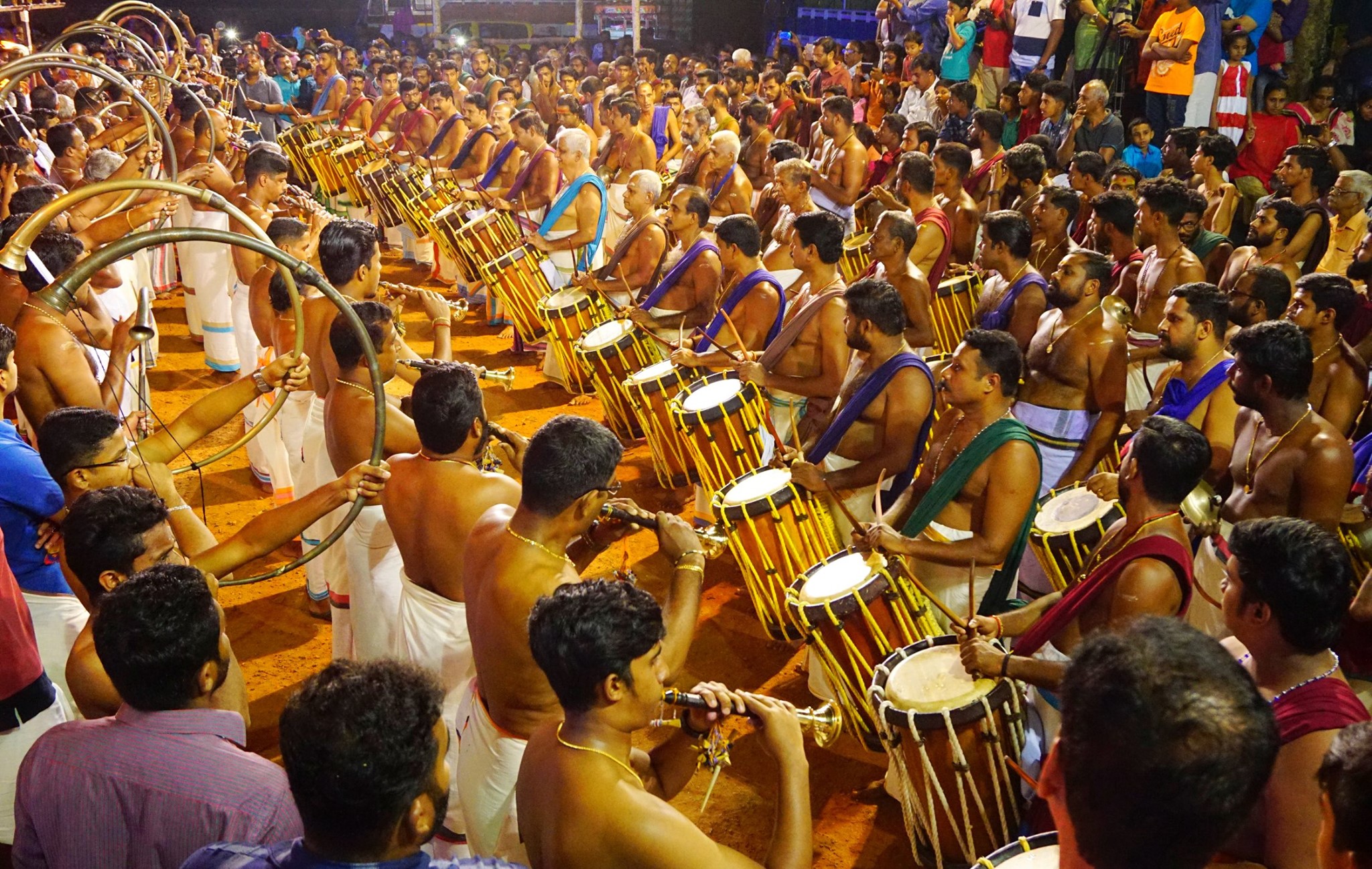
Panchari Melam is a percussion ensemble, performed during temple festivals in Kerala, India. Panchari Melam (or simply panchari), is one of the major forms of Chenda Melam (ethnic drum ensemble), and is the best-known and most popular in the kshetram vadyam (temple percussion) genre. Panchari Melam, comprising instruments like Chenda, Ilathalam, Kombu and Kuzhal, is performed during many temple festivals in central Kerala, where it is presented in arguably the most classical manner. Panchari is also traditionally performed, albeit with a touch of subtle regional difference, in north Kerala (Malabar) and south-central Kerala (Kochi). Of late, its charm has led to its performance even in temples in Kerala’s deep south.
Panchari is a six-beat thaalam (taal) with equivalents like Roopakam in south Indian Carnatic music and Daadra in the northern Hindustani classical.
Chendamelams were already in existence in Kerala hundreds of years ago. Over time, its structure and appearance might have changed. It is said that the present-day Pancharimelam was composed by Pandarathil Raman Marar and Mazhamangalam Namboothiri. It is also believed that it was first performed at the Pooram of Oorakathamma Thiruvadi at Peruvanam Natavazhi. Panchari melam, followed in Peruvanam- Arattupuzha pooram is Orukol Panchari, that means the Idanthala artists (Front row , also called Uruttu chenda) use wooden stick (Chendakol) in one hand and fingers of other hand. This practice enhances the enjoyment and beauty of the Panchari. The beauty of the rhythmic structure of the Panchari is unique and very sweet.
Panchari Melam is performed either in its elaborate form (during annual temple festivals) or in its sketchy detail (to accompany the daily or weekly temple rituals). It would take 4 hours (10 Nazhika) to present a Panchari melam in its elaborate form. Out of this, 105 minutes for Pathikalam (first- Onnam kalam), 30minutes each for second, third and fourth and 45 minutes for fifth kalam, the last one.
A panchari melam has five stages, each of them based on beats totalling 96, 48, 24, 12 and 6 respectively. The first phase of the Panchari Melam, also called the “Pathikaalam” stands out for its unique blend of percussion and notes from the Kuzhal. The crescendo rises higher with each phase, eventually culminating in the fifth phase with a 6-beat cycle. The Melam thus starts with a broad base, and progresses completing the pyramid structure, culminating at the apex.
You can say, Panchari is the theme of Peruvanam-Arattupuzha pooram. Panchari melam is held at almost all the participating temples during pooram season. Panchari melams at, Peruvanam Nadavazhi, Edakunni Bhagavathy temple, Aratupuzha Sastha temple, Thottippal temple, Chakkamkulangara Sastha temple, Thaikkattussery Bhagavathy temple are all very famous.



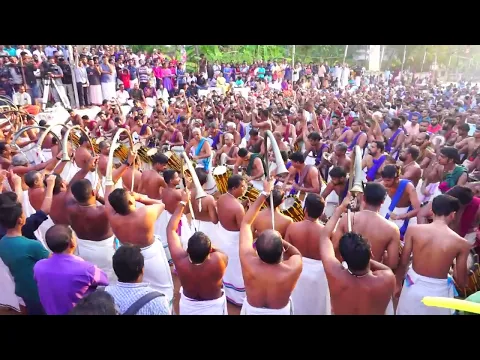

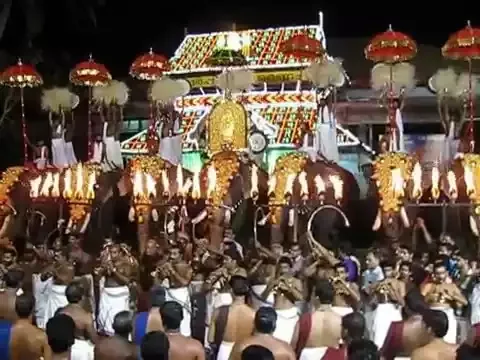

Pandi is a unique Chenda Melam of Kerala. The instruments Edanthala, Valanthala, Kombu, Kuzhal, Elathaalam- and their respective positioning is similar to that of any Melam. Some people believe that Pandi Melam is the oldest of all the Melams. Pandi Melam is usually performed outside the walls of temples (exceptions are there).
Most of the Melams are Chempata-based and bears a relationship with Panchaari. However, Paandi Melam differs from this pattern and is unique and elegant in its style. It bears no relationship with the then Paandi Naatu (Tamil Nadu or another land). The elite community of the time seems to be reluctant to accept a non-traditional Melam and so they gave a sarcastic comment ‘paandi’ –meaning that something that is not of this land. Even today, except on rare occasions, Paandi is not played within the four walls of the temple. During the Pallivetta of any temple festival, the Paandi is the accompanying Melam when the procession reaches outside the walls for darshan of the mass. Pandi reverberates to the brim even is open fields and is the most thrilling experience. Hence this has already earned the most commonly appreciated Melam.
The melam that has been popular here since ancient times is Pandi. Even today, Pandi is played first for all the Poorams in the Peruvanam Nadavazhi. The Pandi melam does not distinguish between Kalams. Unlike in Panchari, the kalam does not end with a descending note before going to next Kalam. The Kalam that is played changes by itself and the next Kalam comes in.
Pandi melam is based on 7 beat thalam called Thripuda. The structure of the Pandi melam is like a Pyramid. First stage starts with beats totaling 14, followed by second stage with 7. Application skills, time control etc increase the solemnity of the Pandi melam.
During Peruvanam – Arattupuzha pooram , Pandi melam is held at many participating temples. Most famous Pandi melams are of Makeeram Purappadu of Cherpu Bhagavthy and Urakathamma thiruvadi, Arattupuzha Sastha’s Peruvanam pooram and Tharakkal pooram. It is also held for Nettisserry Sastha’s Arattupuzha pooram and Atham day evening pooram, Medamkulangara Sastha’s Atham Kodikuth pooram, Makeeram Porappadu and Arattupuzha pooram of Thriprayar Thevar. At Peruvanam, prior to start Panchari melam, Pandi melam is played in a brief form.
Instruments
The Chenda (Malayalam: ചെണ്ട) is a cylindrical percussion instrument originating in the state of Kerala and widely used in Tulu Nadu of Karnataka and Tamil Nadu in India. In Tulu Nadu (Coastal Karnataka), it is known as chende. It is greatly identified as a cultural element in Kerala and Tulu Nadu. This instrument is famous for its loud and rigid sound. A Chenda has two sides, “Edamthala” (ഇടം തല)(Left Head) and “Valamthala” (വലം തല)(Right Head). The “Edamthala” is made of only one/two layer of cow skin and the “Valamthala” will have a five/seven layer skin, so as to have a bass sound. The skin are dried in the shade and fastened on wooden rings (Chenda Vattam, ചെണ്ട വട്ടം) made of the trunk of a locally available palm tree (Eeranpana) or bamboo, using a gum prepared from the seed of a tree called “pananchi maram”. The body of the Chenda which is approximately 1 foot (30 cm) in diameter and 1.5 inches (3.8 cm) in thickness is made of the soft wood of the jackfruit tree (വരിക്ക പ്ലാവ്) (Varikka Plavu). Only the wooden rings with the skin (Chenda Vattam) are replaced once the quality of the sound is not up to the mark. Valamthala is considered as Deva vadyam and Edanthala as Asura vadyam. The Chenda is mainly played in Hindu temple festivals and as an accompaniment in the religious art forms of Kerala. The chenda is used as an accompaniment for Kathakali, Koodiyattam, Kannyar Kali, Theyyam and among many forms of dances and rituals in Kerala. It is also played in a dance-drama called Yakshagana (Tenku Thittu) which is popular in Tulu Nadu in Karnataka. There is a variant of this instrument used in northern school of Yakshagana called Chande. Depending upon the function of the Chenda, they are classified as, “Veekkam Chenda” (വീക്കം ചെണ്ട) or “Uruttu Chenda” (ഉരുട്ട് ചെണ്ട), ” “Uruttu Chenda” (ഉരുട്ട് ചെണ്ട) is used to play variations in music. It is used to lead the orchestra. It is called the “”Pramanavadhya”” (Leading instrument). The “Chenda Vattam” (ചെണ്ട വട്ടം) of the “Uruttu Chenda” is always the “Edam Thala” or the “Left Head” which is made of soft, single cow skin. The meaning of “uruttu” (ഉരുട്ട്) in Malayalam language is “rolling”. The artist produce sound on “Uruttu Chenda” by rolling his hand wrist. “Veekkam Chenda” (വീക്കം ചെണ്ട) is used to keep the “thalam” (താളം) or the basic rhythm. The “Chenda Vattam” (ചെണ്ട വട്ടം) of the “Veekkam Chenda” is always the “Valam Thala” or the “Right Head” which is made of multiple layer of skin to produce a bass sound.
Elathalam, or Ilathalam, is a metallic musical instrument (Ghana vadyam -ഘനവാദ്യം in Malayalam) which resembles a miniature pair of cymbals. This instrument from Kerala in southern India is completely made out of bronze and has two pieces in it. A string is passed through a hole in the middle of the leaf cymbal and rings are attached to the string. Ilathalam is played by keeping one part of the cymbal in left hand banging the other cymbal to the one in left hand. Even though this instrument is small by size, it does have more thickness than the common cymbal, and thus gives a distinct chime. Ilathalam is never a lead instrument but is used in a number of ethnic Kerala percussion ensembles like Panchavadyam, Chenda melam and Thayambaka. It is also used by the second singer in a Kathakali performance, and to provide the beat in Kuzhal Pattu and Kombu Pattu. The name ilathalam comes from its resemblance to a lotus flower, or tamara in Malayalam.
The Kombu ( Malayalam: കൊമ്പ്) is a wind instrument (horn) usually played along with Panchavadyam, Pandi Melam, Panchari melam etc. This musical instrument is usually seen in south India. The instrument is like a long horn (Kombu in Malayalam). In recent research found that the kombu resembles trumpets being used in ancient Ireland and felt this was evidence of a link between peoples in South India and those in Ireland, 2000 years ago. In ancient days kombu played during war along with certain type of drum. Modern kombu made out of bronze either in ‘C’ shape or ‘S’ shape. In Kerala ‘C’ shaped Kombu is used and it plays an important role in the Panchavadyam and all types of Melams like Pandi, Panchari, Chembada etc. However, as prelude to melams, it is also used to present solo concert (with Ilathalam, a miniature pair of cymbals, as accompanying instrument), in which case it is called Kombu Pattu. The Kombu is a wind instrument. It is a curved tubular instrument made of bronze. It has three parts: a lower part that is the size of a little finger and is held in the mouth, a middle part that gradually increases in diameter, and an upper part that increases in diameter and is open. These three parts are separated and reassembled when it is time to blow. It requires breath control and good practice to blow it..
The Kurumkuzhal is a wind instrument (Sushira vadyam in Malayalam) that originated in Kerala, India. Also called the kuzhal or mukha veena, it’s similar to the Nadaswaram and large Shehnai. It is mae from wood with a conical bore and a brass bell at the end. The player blows through a double reed and closes small holes with both hands. It has a shrill and penetrating tone. Used in temple festival rituals, such as vilakku acharam, and as an accompaniment to chenda-led ensembles. Kuzhal is primarily used as an accompaniment for chenda-led ensembles Panchari Melam and Pandi Melam, where the piper plays the anchor role. However, as prelude to melams, it is also used to present solo concert (with a couple of accompanying instruments- Idanthala chenda, Ilathalam), in which case it is called Kuzhal Pattu. The instrument has a wooden body with a conical bore, at the end of which is affixed a brass bell. The player blows through a double reed and closes small holes with both hands. The kurumkuzhal is the instrument used to set the rhythm of the melam. Although the melam is led by the Edantala Chenda artists, the kurumkuzhal players are just as important as them. The kuzhal players give advance warning of the upcoming stages in the melam. They do this by bending over, encircling and twirling kuzhal by holding it in their hands.
Photos


