

History of Koothu Koodiyattam
The Koothu is a solo theatre performance which may be performed independently or as a part of a koodiysattam ensemble. Koodiyattam which literally translates to ‘acting together’ emphasizes expressiveness or abhinayam. It was originally performed privately within temples and its occurrence before a big audience is a recent phenomenon. Initially, each of the eighteen nadus of Kerala had one troupe or family that was conferred the right to perform Koodiyattam, many of which have become extinct or have migrated to other places from their hometowns. Both forms of ancient theatre are traditionally performed between the 20th day of the month of Midhunam to the 1st of Chingam in a theatre space called the koothambalam.
Types of Koothu Koodiyattam
Peruvanam was famous for its Chakyar Kooth. (Now, Kooth is not held at the Peruvanam Mahadeva Temple). It is held at Koothambalam. In the past, two Chakyar families, Kuttenchery and Meykkadu, had the right to perform Kooth here. Later, the Mani family also got the right to perform Kooth. At Peruvanam, three stories are usually used for the Koothu. They are Anguliyankam, Manthrankam and Matthavilasam. Every year, Anguliyangam starts on the 20th of Mithunam (Malayalam month). It ends the day before the Karkkidaka Sankrama. Then, at the time of the Sankrama, the Manthrankam koothu begins. This continues until the first of the Chingam month. On the first of the Chingam month, Valiyakoodiyattam is held which marks the end of the event for that year. Matthavilasam koothu is held as an offering. It is performed when there is no other koothu.
Out of three, Anguliyankam is cosidered as vaishanavam, Matthavilasam is shaivam and Manthrankam is both.
The great artist Sri Mani Madhava chakyar had performed at Peruvanam temple. Mani Neelankandan Chakyar performed koothu many years at Peruvanam.
Peruvanam Mahadeva temple was the one of the rare venues where all the three, Anguliyakam, Manthrankam and Matthavilasam were held. Usually Manthrankam koothu takes 41 days to complete. But at Peruvanam Mahadeva temple it is completed in 28 days. Also, at Peruvanam, full and new moon days and the day after that are off days for koothu performance.
Out of all daily poojas, Ucha pooja at Peruvanam Mahadeva temple is conducted by Thiruvithamkoor Devaswam. And holding Chakyar koothu also Thiruvithamkoor devaswam’s responsibility. But nowadays devaswam does not take any interest morally and financially to hold traditional Chakyar koothu at Peruvanam.
Chakyar Koothu is a performance art from Kerala, India. It is primarily a type of highly refined monologue where the performer narrates episodes from Hindu epics (such as the Ramayana and the Mahabharata) and stories from the Puranas. Sometimes it incorporates commentary on current socio-political events and personal comments directed at the members of the audience, in a humorous way so that listeners enjoy the Koothu and won’t feel it as hostile.
Koodiyattam, meaning “combined act” in Malayalam, combines Sanskrit theatre performance with elements of Koothu, an ancient performing art from the Sangam era. It is officially recognized by UNESCO as a Masterpiece of the Oral and Intangible Heritage of Humanity.
Both are performed in the Koothambalam; a place inside Hindu temples specifically designed for performing Koodiyattam and Chakyar Koothu. Ideally, the performance takes place in conjunction with festivals, presented by members of the Chakyar community along with the Ambalavasi Nambiars.
Koothu is a solo performance, by a narrator in a distinctive headgear and black moustache with his torso smeared with sandalwood paste and red dots all over the body. The headgear resembles snake’s hood, to symbolise the narration by Anantha, the thousand headed serpent.[1]
The Chakyar narrates the story based on the Sanskrit style of “Champu Prabandha” – a mixture of prose (gadya) and poetry (shloka). He begins with a prayer to the deity of the temple. He then goes on to narrate a verse in Sanskrit before explaining it in Malayalam. The narration uses wit and humor to draw parallels with current events and local situations.
Koothu has traditionally been performed only by the Chakyar community. Two instruments accompany the performance – a Mizhavu and a pair of Kuzhithalam. This is different from the Nangiar Koothu, which is performed by women called Nangyarammas who belong to the Nambiar caste, and is a more highly refined theatre art. On some occasions, other than Mizhavu and Kuzhithalam, Thimila and Idakka are used in Chakyar koothu.
Mani Madhava Chakyar, Ammannur Parameswara Chakyar ( Chachu Chakayar), Ammannur Madhava Chakyar, Painkulam Raman chakyar and Mani Neelakandan Chakyar were the some of the great figures in Chakyar Koothu.
Koodiyattam is the only surviving art form that uses drama from ancient Sanskrit theatre. It has a documented history of a thousand years in Kerala, but its origins are not known. Koodiyattam and Chakyar koothu were among the dramatized dance worship services in the temples of ancient India, particularly Kerala. Both koodiyattam and Chakyar koothu originated from the ancient art form koothu, which is mentioned several times in Sangam literature, and the epigraphs of the subsequent Pallava, Pandiyan, Chera, and Chola periods.
The name “koodiyattam”, meaning playing or performing together, is thought to refer to the presence of multiple actors on stage who act in rhythm with the beats of the mizhavu drummers. Alternatively, it may also be a reference to a common practice in Sanskrit drama where a single actor who has performed solo for several nights is joined by another.
A complete Koodiyattam performance consists of three parts. The first of these is the purappadu where an actor performs a verse along with the nritta aspect of dance. Following this is the nirvahanam where the actor, using abhinaya, presents the mood of the main character of the play. The final part of the performance is the koodiyattam, which is the play itself. While the first two parts are solo acts, koodiyattam can have as many characters as are required to perform on the stage.
There are some rituals for the Manthrankam Kooth. It begins during the time of Sankrama. The lamp is brought from Sanctum sanctorum. There are rituals for it too. A stick of 2 ‘Kol’ (72×2 cm) 11 fingers (11×3 cm) length, made out of Milkwood (Alstonia scholaris), is required. A conch shell shape is drawn on it and silk cloth and money are tied. The priest keep the stick slanting on the pedestal and lights the lamp. Then the lit lamp and the stick are given to the Chakyar. On the last day, after ‘Valiya Koodiyattam’, Chakyar performs Danda namaskar followed by rituals Muttappu and Mudiyakkitha kottiykka. Then burn the stick (Dandu).
It requires three days to perform Mathavilasam koothu. Permission of Thanthri (main priest) is a must prior to start Mathavilasam koothu. It is held as offering.


Instruments
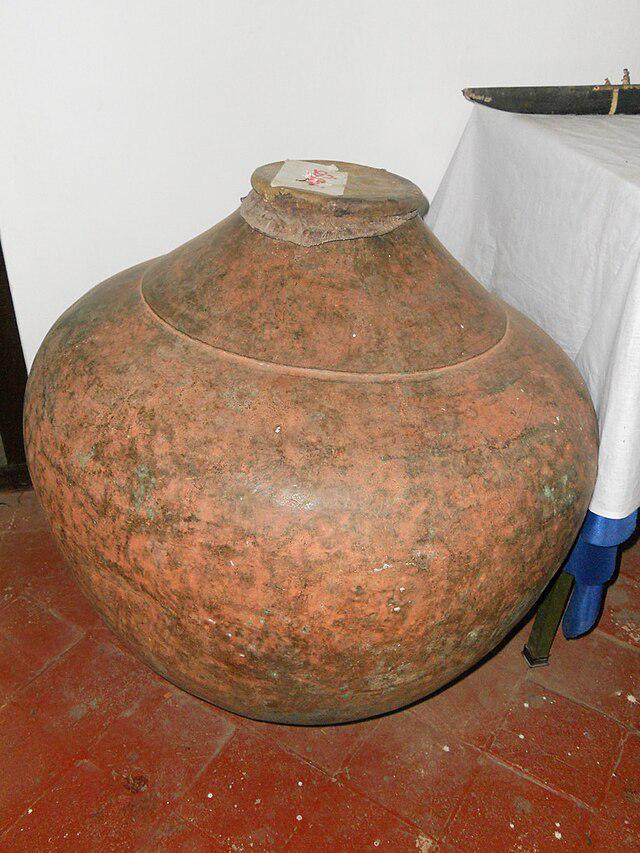
A Mizhavu (Malayalam: മിഴാവ്) is a big copper drum played as an accompanying percussion instrument in the Koodiyattam and Koothu, performing arts of Kerala. It is a large, copper pot with a narrow mouth covered with wet calf hide. It is usually placed in a wooden frame called a Mizhavana because of its tapered base
The Mizhavu is played by striking the hide with the player’s bare hands to produce rhythmic notes. The tone of the instrument increases as the skin dries. The Mizhavu is primarily used as an accompaniment to Kerala’s temple arts, such as Koothu, Koodiyattam, and Nangiarkoothu. However, its deep sound also makes it suitable for solo performances. The Mizhavu was originally made of clay, but is now more commonly made of copper.
According to an old legend, the goddess Saraswati, who is the embodiment of art and literature, once fell from heaven to this area in the form of a Mizhavua which is considered as a divine instrument . The place where the Mizhavu fell later became Mizhavu kunnu. Over time, it changed to Mizhakunnu – Mozhakunnu and reached the present name Muzhakunnu. There is a sunken area inside the temple, where It is believed that the Mizhavu fell. Today, the spot where it fell down is considered as Moolasthanam of goddess ( the place of consecration). This is a deity covered with puttu (mound of earth).
Mizhavu is treated as a “Brahmachaarya” and it is considered as sacred. It is used to accompany the holy ritualistic temple performance of Koodiyattam and Koothu. After 1965, when started a Mizhavu repertory in kalamandalam, mizhavu break the caste barrier and nowadays anyone can play Mizhavu in Koodiyattam, Nangiar koothu, Chakyar koothu, and Mizhavu thayambaka. But, only Ambalavasi Nambiar community members are allowed to play it inside temples or Koothambalams still.
There is a belief that if the ‘Mizhavu’, used in Koothambalam, were to be damaged or worn out, it could only be discarded after certain rituals were observed. Repair and reuse of this sacred instrument was not allowed. This is applicable only for those in Koothambalam of the temples. Some of these traditional beliefs continue to prevail even today amongst the present generation of Mizhavu players.
The Mizhavu is placed in the centre of the stage behind the actor. For most Kutiyattam plays, two Mizhavus are used and in Chakyarkuttu only one is used. The Mizhavu player has to follow and play according to the moods, movements and expressions and hand gestures or mudras of the actors. He must also have an in-depth knowledge of Sanskrit, Prakrit, and the ancient Tamil language. He must also be thoroughly familiar with the scripts of the play called the Kramadeepika.
The cymbal used in Koothu and Koodiyattam is called ‘Kuzhithalam’. Kuzhithalam (a miniature pair of cymbals) is a very small version of Ilathalam which is used in Percussion. Kuzhithalam is used to keep the rhythm in Koothu and Koodiyattam. This instrument from Kerala in southern India is completely made out of bronze and has two pieces in it. Kuzhithalam is played by keeping one part of the cymbal in left hand banging the other cymbal to the one in left hand It is a part of Indian music and culture, used in various traditional customs.
.
Photos